

Never have I ever cooked on a Yoder Smokers model… until now. Today we’re putting their premium pellet grill flagship model, the Yoder Smokers YS640s, to the test to see if it’s really the best pellet grill on the market, or if it’s an overhyped grill purchase that you really don’t need.
Quick Links to the products mentioned in this post:
- Yoder YS640s competition cart
- Yoder YS640s standard cart
- Yoder YS640s built-in
- Yoder YS640s built-in island
- Yoder cast iron griddle insert
- Yoder Smokers pizza oven
- Fireboard Pulse thermometer
- Pork Protocol seasoning
- Feathered Formula seasoning
- Lone Star Grillz cabinet smoker
- Weber Searwood XL
- Traeger Timberline
When Yoder Smokers asked if we wanted to get hands on with their flagship pellet smoker, we knew that many of you had been waiting for this day. I’ve read your DM’s and emails for years, and today is finally the day. This content isn’t sponsored, there’s no manufacturer notes and our thoughts are our own.
We’re going to measure if the grill heats evenly, see how it does with a hot and fast wing cook, do an overnight cook with 6 pork butts low and slow, test direct searing, torture the griddle accessory and a whole lot more.
Yoder Smokers YS640S Build Quality
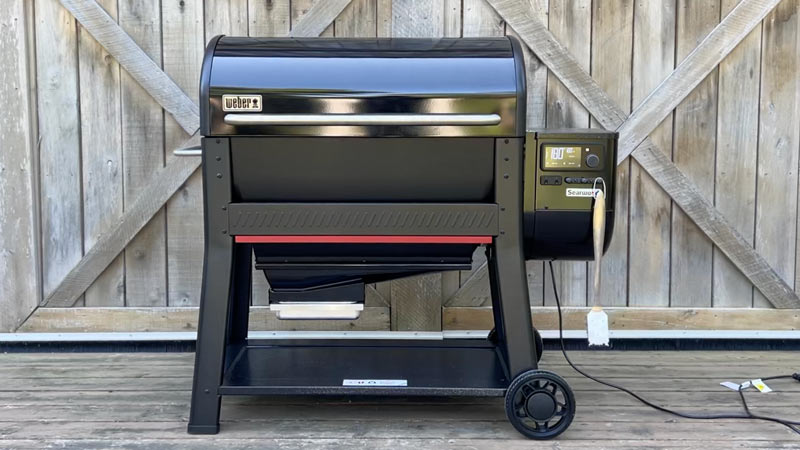
To start, let’s address the build on the YS640s compared to other pellet grills on the market. For comparison, a grill that has done really well in our testing in the past is the Weber Searwood XL, and it weighs 157 pounds. When you compare it to the YS640, the Yoder weighs in at 418 pounds as we have it here.
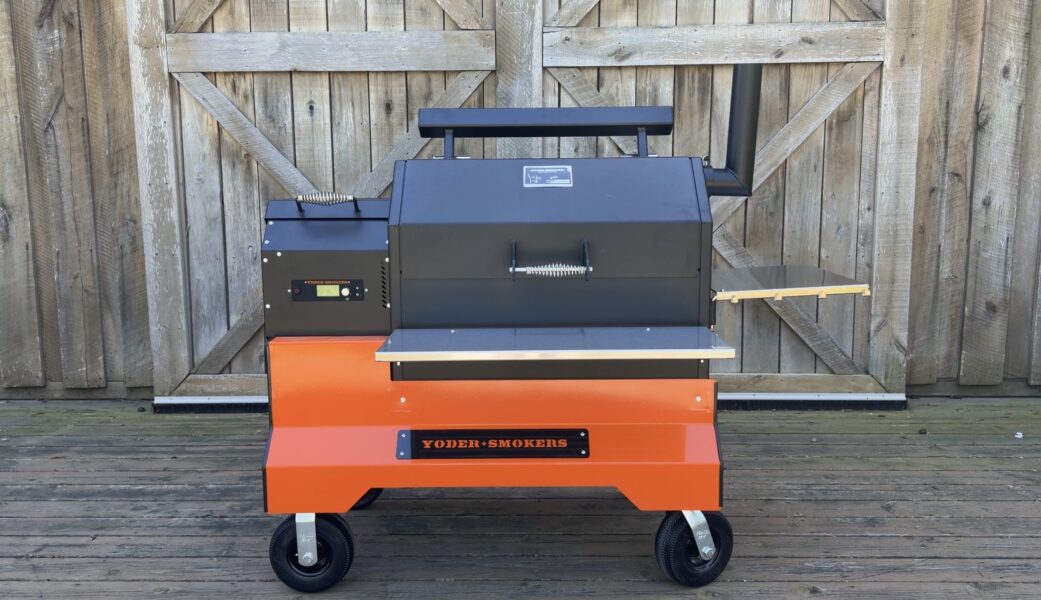
It’s hard to believe how thick each piece of metal is on this grill. It was easily the first thing I noticed, and it’s significant. The cooking chamber steel thickness is 1/8th of an inch thick.
The grill measures a little over 61 inches wide including the side shelf, 55 inches high to the top of the exhaust stack and has a depth of a little over 28 inches including the wheels and the handle.
The pellet hopper holds 20 pounds of wood pellets, and there is notably not a pellet dump, so to change pellet flavors it’s either the Shop Vac or a small cup to empty out the current contents.
The controller is a Fireboard Controller, so if you’ve watched our videos on the Fireboard Drive or the Pulse, those wireless thermometer probes are compatible with this grill, which I love. I’ll show those in action in a few minutes.
The Yoder YS640s also comes with 2 wired probes when it ships, and there are two probe ports in the front of the controller.
Inside the cooking chamber, there are 4 main grates for a total of 640 square inches of cooking surface on the main level. With the upper rack, there’s another 430 square inches for a total of 1,070 inches of cooking space.
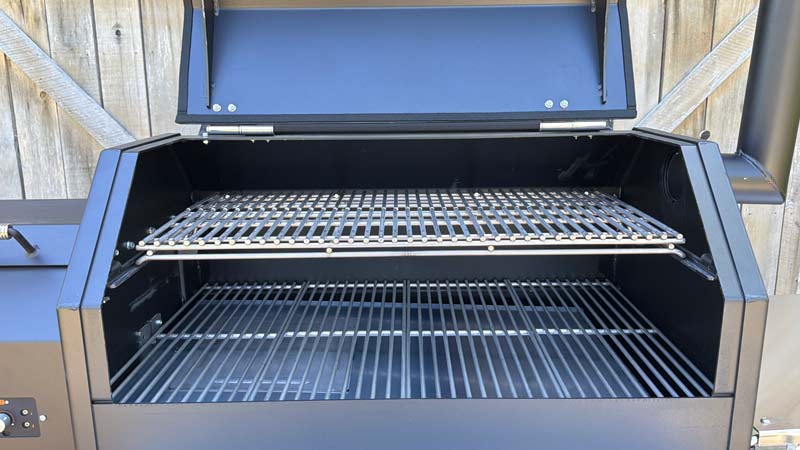
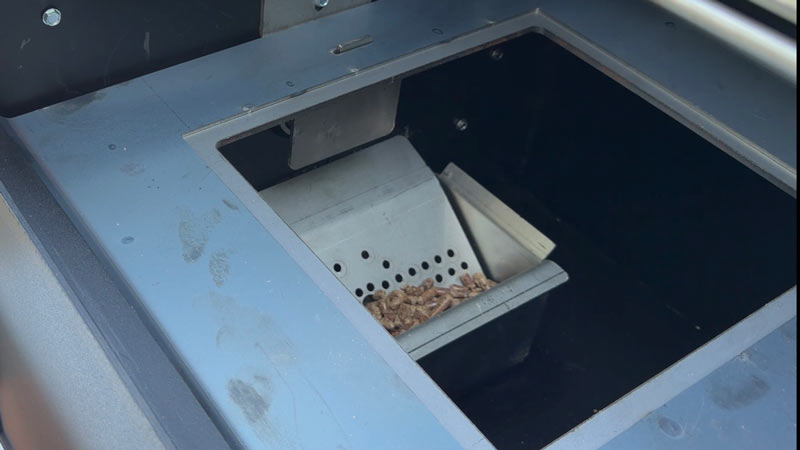
Under the grates, there’s a substantial diffuser plate ensuring indirect heat across the entire grill. On the left side, a panel can be removed for direct over the fire grilling, which sets it apart from most pellet grills. The wood pellets fall into the burn tray in a waterfall design, and instead of a circular burn cup, it’s more of a burn tray firebox that’s quite wide. I’ll show you how that affects direct flame grilling in just a few minutes.
Competition Cart vs. Standard Cart vs. Built-in
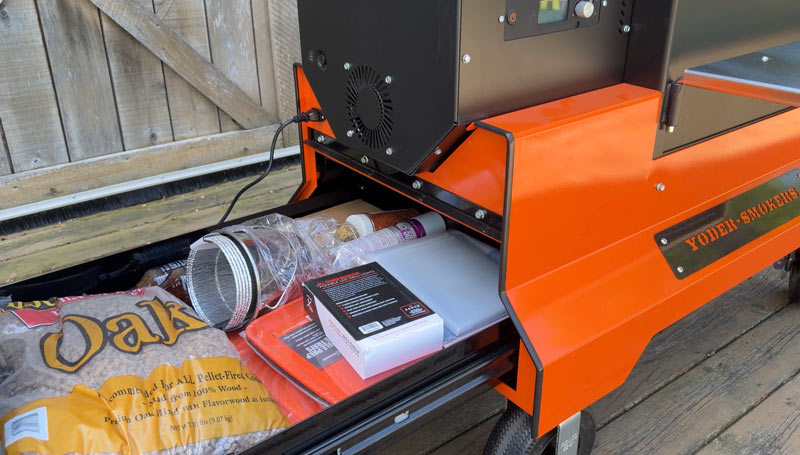
I would be remiss if I didn’t address the cart on this grill, since this is the top of the line cart that Yoder offers. This is the Competition Cart with Storage Drawer. This is an upgrade from the standard cart, and the difference in price between the standard cart and this top of the line comp cart and drawer is about $1,300 at the time of this video.
So, it’s basically the cost of an imported pellet smoker to make this upgrade, and here’s what it gets you. The tires are rubber, unlike almost all pellet grill wheels on the market that are made of molded plastic. Two wheels are static and the other two rotate 360 degrees. There are wheel locks on two wheels, and moving it around takes a little effort to get it going, primarily because of the rubber wheels and the grill weighing over 400 pounds.
The competition cart with storage drawer also includes the upgraded stainless steel shelves, which are optional add-ons for the other cart models where wire racks come standard.
In my opinion, the drawer is the star of the show. Just turn the handle, give it a little tug and the drawer slides out. To say it’s absolutely huge would be an understatement. There are photos on the All Things Barbecue website showing it holding the pizza oven accessory, grill grates and more, and after seeing it in person, I really didn’t have a concept of just how large it is.
It’s called a Competition Cart, I assume, because of its designed mobility for activities like BBQ competitions, and having a drawer this large on the grill keeps everything where you want it while you’re on the go.
I haven’t actually had hands on the standard cart to assess its quality, but judging by the metal used throughout the grill, I’m certain it’s no slouch and can certainly get the job done well if you’re planning on leaving your Yoder YS640s sitting on your back patio and not moving it around much.
It’s also worth noting that Yoder Smokers also offers the YS640s as a built-in model if you’re thinking about including it in a more permanent outdoor kitchen setup.
Yoder Smokers YS640s: Made in America
Yoder Smokers are manufactured in the United States, in Hutchinson, Kansas. This is an American Made grill, and that’s one of the things that I believe makes it such a aspirational goal for most of us involved in the American BBQ lifestyle.
I don’t know the exact metric, but based on what we test here at The Barbecue Lab I would estimate that over 90% of the grills sold in America are made overseas, and a truly American Made grill is quite a unicorn in today’s outdoor cooking landscape. There’s so much more I could cover, but let’s fire this thing up and see what kind of performance you should be able to expect from this machine.
Pellet Smoker Cooking Tests
Overnight Pork Butt cook
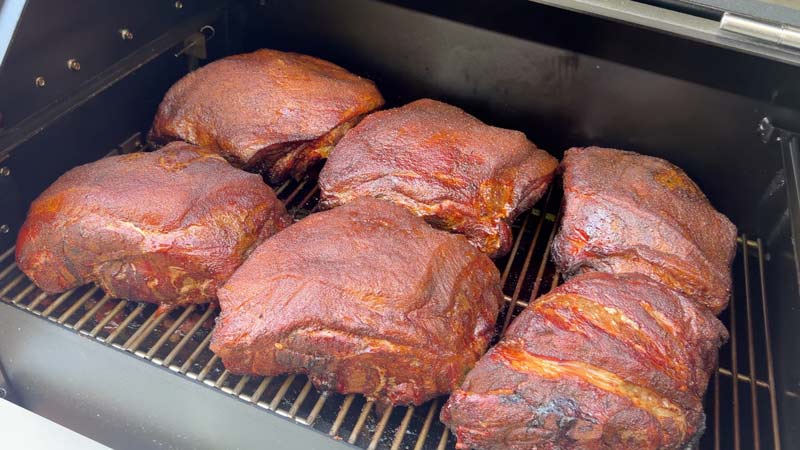
To test the YS640s on a low and slow cook, there isn’t a much lower and slower cook than an overnight pork butt cook. We were cooking some carnita style pork for tacos at church for the youth group, so I grabbed a case of pork butts, seasoned them with our Mexican seasoning that I’ve been working on and set them to run overnight in the Yoder at 200° Fahrenheit.
Here’s the graph from the Fireboard app showing how the grill performed overnight, and when I checked in the next day, the pork was looking amazing. I wrapped the pork, turned the grill up to 250, and just a few short hours later, the butts hit the cooler for a 6 hour rest. At the event, volunteers pulled and sauced the pork, and the YS640s handled 6 pork butts without breaking a sweat.
BBQ Party Ribs
For something just a little hotter than low and slow at 275°, I cooked a couple of racks of back ribs party style for family on Memorial Day.
I covered the individual ribs with our Pork Protocol seasoning that we make small batch in our Indiana studio, and placed them on the grill for a quick smoke bath. After 45 minutes, I flipped them, and after another 45 minutes, I was very pleased with the color the Yoder was putting on our ribs.
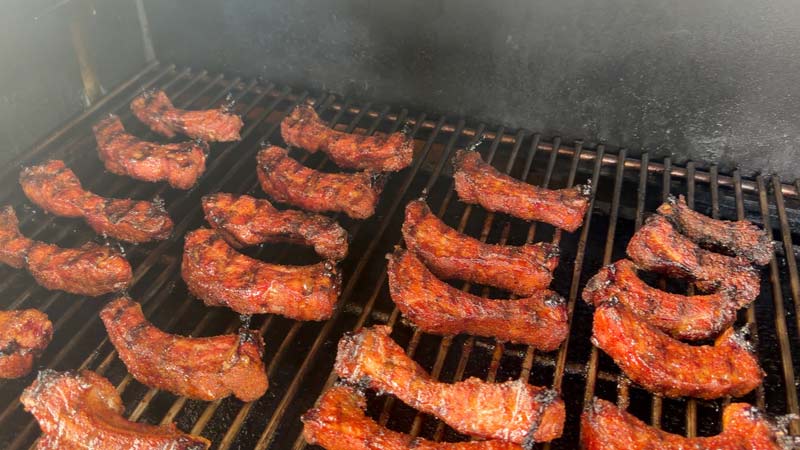
I coated them in our bbq sauce, butter and some brown sugar, and covered them in a pan. About an hour in the wrap, and the ribs were the star of the show at dinner. They were easy and under 3 hours on the Yoder YS640.
Biscuit Test
For every pellet grill we test, I want to know the cooking evenness of the grill, and one of the best ways for me to visualize that is by baking a can of biscuits across the grate. Instead of a can this time, I had a bag of frozen biscuits in the freezer and they called for 375° Fahrenheit for 20-24 minutes. So I set the grill to 375, laid the biscuits across the grate and set a timer. After 20 minutes, here’s what the biscuits looked when they were flipped over.
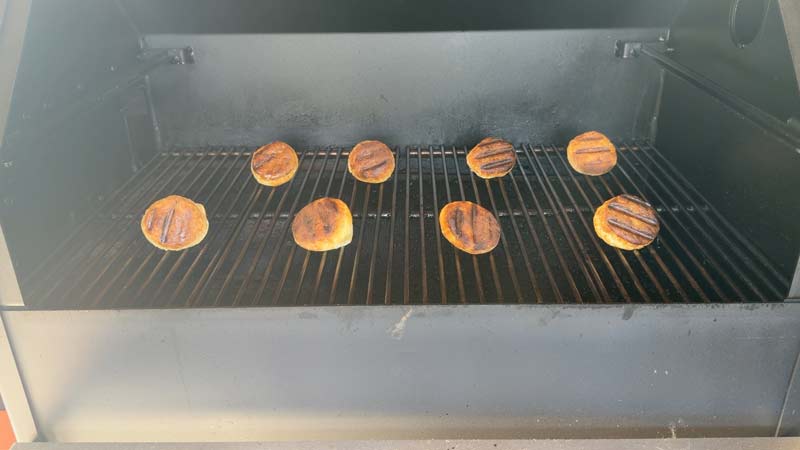
The doneness on each of the biscuits was even across the grate, so I didn’t get uneven cooking on the bottom. They were more done on the bottom than the top, which is to be expected during this test.
Pellet Grilled Hamburgers
One of the biggest struggles for any pellet grill is grilling. I know that sounds strange, but most pellet grills are indirect smokers with a giant diffuser plate and not direct grills. The Yoder has a deflector underneath the grate that keeps it from being a direct cooker, but it has a pull out panel that allows you to cook directly over the pellet firebox.
It’s a significant fire compared to other models of pellet grills that burn in a tiny circular cup. The Yoder is designed in more of a waterfall pellet method, with the pellets falling into a wide trough that increases the area of the fire instead of a round 3 inch cup.
To test this, I pulled out the access door and fired the grill up to 600 degrees. I picked up some quarter pound frozen burger patties at Kroger and placed 4 burgers over the open flame to see what kind of coverage I could get. Some burgers were more done than others at the flip, but I think that’s due to the pellets being able to spread out in the burn trough, making the flame consistently inconsistent. The first batch, I thought the back right burger was much farther along than the rest at the flip, but in the second batch, it seemed like it was the front right and the back left that was ahead.
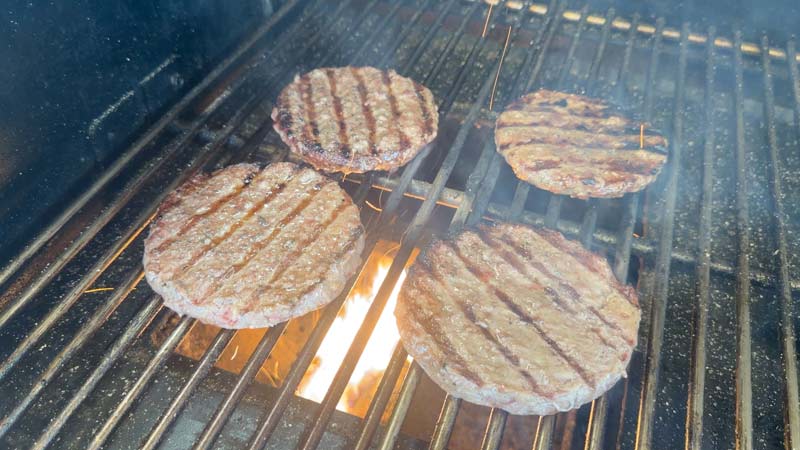
Curious if my pellet distribution theory is correct or not, but I will say that this grill easily outperforms any pellet grill that has a full deflector when it comes to grilling. There are a few grills from other manufacturers with a small deflector opening where you can grill over the burn pot, but in my experience it’s 1 burger at a time, and the Yoder easily handles 4 at a time, so the win goes to Yoder hands down on this ability.
Reverse Sear Ribeye
While the deflector plate was open for the burger test, it seemed like a great time to test the optional griddle accessory. I wanted to see how the addition of the griddle would allow for reverse searing a couple ribeye steaks.
I set the grill to 180°, plugged in a wireless Fireboard Pulse to each steak, and set our doneness notification to 110°. I set the steaks on the far right side of the grill to soak up some of the smoke flavor from the wood pellets and let the Fireboard app notify me when the steaks were done with the first part of the cook.
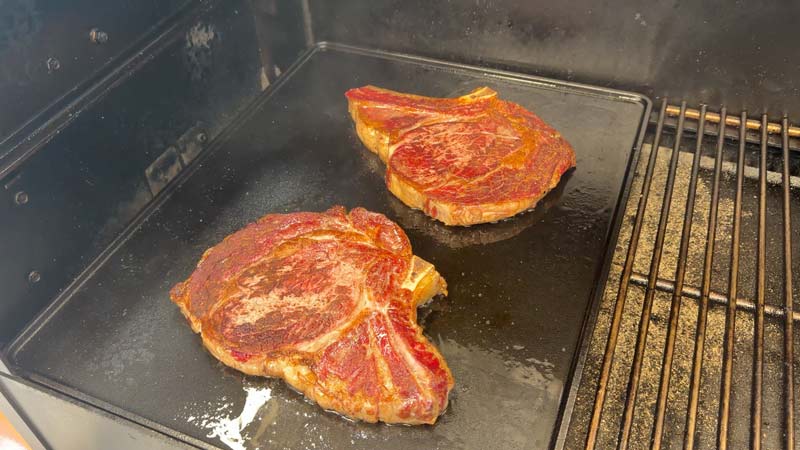
I pulled the steaks off to rest and turned the grill up to 500° Fahrenheit. A quick baste with olive oil and cracked black pepper, and each steak went straight on the griddle for a sear. Just 60 seconds on the first side, and at the flip, here’s what our steaks looked like.
Incredible searing capability on a pellet grill. I’m impressed. One machine, dual function.
Griddle Pancakes
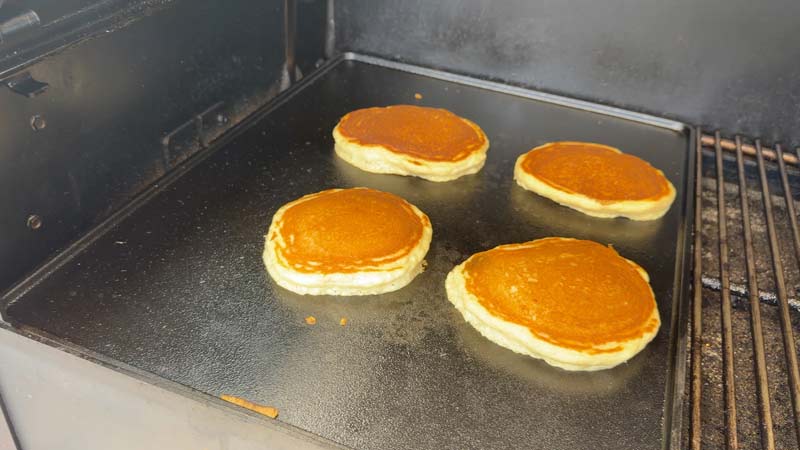
The next morning, I turned the grill up to about 275° to try my hand at a batch of (gluten free) buttermilk pancakes on the griddle.
I let the cast iron griddle heat up for about a half hour, and I’m guessing here since it’s my first time using the griddle accessory and trying to control it at a lower temperature. Also, Melissa is usually the pancake maker in our house, so I’m not as skilled as her.
Here’s where I messed up. I didn’t temp the surface first and placed down 8 pancakes. Turns out I was only running about 275 on the surface, so the pancakes spread into each other and I had a mess on my hands. At this low of a temperature, the middle 4 pancakes were done well before the others, which makes sense based on where the hole in the deflector plate is located.
I was looking for a surface temperature of 300-350° and I found that setting it to 350 achieved a griddle temp of about 370 for the next batch. I focused on just the middle of the griddle, and with 4 pancakes in that zone, they each cooked perfectly in the amount of time I would expect.
There’s obviously more testing to do around this griddle, but hopefully a few of you can learn from my mistakes. Invest in a good infrared thermometer, it’s your friend when you’re working with a flat top.
Chicken Wings
We do chicken wings about once a week here at the house, and our Feathered Formula chicken rub is our go to for wing night.
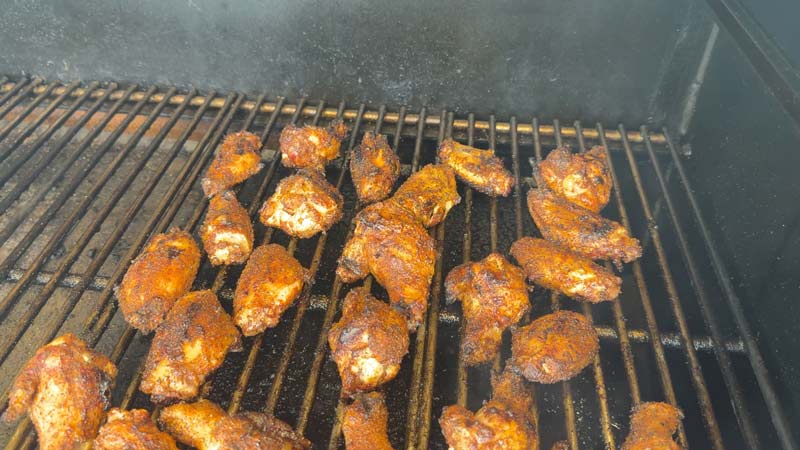
I set the pellet grill to 400 degrees, cut the wings into party size and covered them by tossing them around in a bowl with our rub. I put them on the right hand side of the grill so they weren’t directly over the fire burn cup area, and set a timer for 15 minutes. After a flip, 15 more minutes, another flip, and a final 10 minutes on the Yoder and our wings were done with a nice crispy exterior.
My Final Thoughts on the Yoder Smokers YS640s
I’ve been testing this pellet grill for about a month now, and here are some thoughts I’ve had along the way.
- I absolutely love the storage drawer, but the power cord can get in the way. I wish there was a way to pin the power cord out of the way of the drawer since it sits right overhead. I’m sure there’s a command strip for that.
- With the Yoder YS640S, I notice heavier visual smoke than what I get from most other pellet grills I’ve tested. This puts out smoke like the pellet grill cabinet from Lone Star Grillz and the Weber Searwood. Those two have been the smokiest pellet grills I’ve tested, and this is right there with them.
- This is the best implementation of the direct over the burn cup grilling idea that I’ve tested. It’s much better than the small circular burn cups found in $500 to $1,000 grills. My experience has been that those can grill 1 burger at a time, and this one will do 4 at a time. That’s very noteworthy if you’re looking for just 1 grill on the patio that can smoke and sear.
- I also love the optional griddle top that gives the griddle functionality as well making it a triple threat. Could the griddle surface heat more evenly? Probably, but with just 1 pellet burn area, I don’t see a way to distribute heat evenly without adding complicated distribution systems.
- The Rubber Wheels are a little hard to get started if they’re not aligned with the direction you’re heading. It’s 400lbs of grill, so alignment is key. Once you’re lined up though, moving it across the yard wasn’t any problem at all.
- I’m guessing this is an assembly error on my part, but the smokestack leaks liquid smoke on to the side shelf. I need to take it apart and figure that out.
- I know there are some concerns about how this type of metal holds up to the elements over time. I can’t really speak to that in this video since we’re just a month into working with it. I know that it comes with touch up paint when the grill is delivered, so my assumption is that there’s some maintenance expected over the life of the grill.
- The warranty is 10 years on the cooking chamber, and for the rest you can find more details on the website.
- I find that most pellet grills are finicky, and I need to clean the burn cup out every 2-3 cooks or it won’t start. This grill started every time I turned it on, and in all of our tests, I only brushed the ash out of the burn area twice, so that’s remarkable to me. There are holes on the bottom of the burn trough so the ash can fall into the bottom of the grill instead of clogging up the burn area.
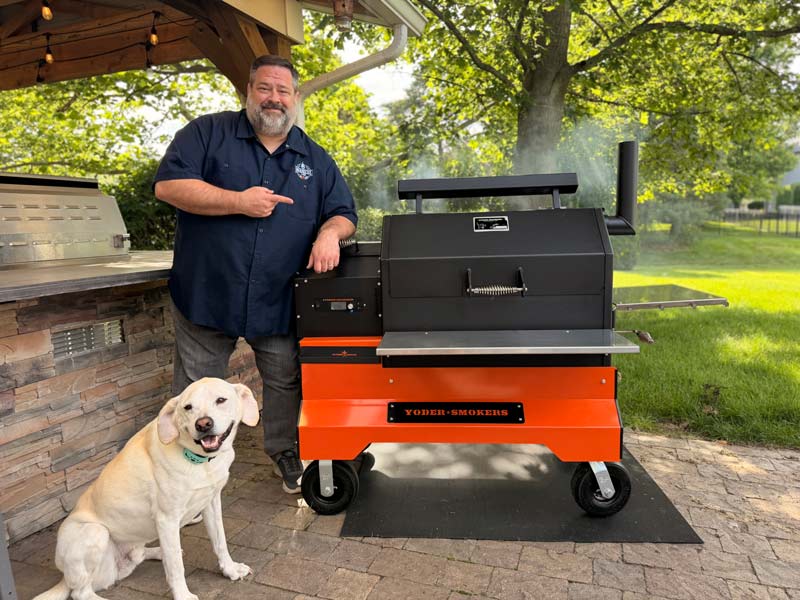
If you’ve watched the channel before, you’ve probably seen our pellet grill roundups where we pit grills against each other of a similar size and price point. We would probably never put this pellet grill in one of our roundups because it just wouldn’t be a fair comparison. The size would be comparable, but the fact that it’s American made and built 4 times heavier than other grills makes it an outlier.
This pellet grill is just built on a whole other level from most of the pellet grills we’ve tested here. The only one that even compares would be the Lonestar Grillz Cabinet smoker. Both pellet grills are built in the USA with a whole lot more metal and longevity.
The Yoder YS640s costs significantly more than most of what you’d find in a big box store, but there are a few comparisons. Depending on how you would think about outfitting your Yoder, pricewise it falls in the same ballpark as the Traeger Timberline. The build quality and materials are nowhere near the same quality with Yoder outshining the Traeger easily. The Traeger does come with an induction side burner, so it has the Yoder on that point, but it would really be a hard sell to convince me to pick up a Traeger over this Yoder.
I know that not everyone has a few thousand dollars to spend on a pellet grill, but for those that do, there are choices to be made that can impact how long your grill lasts.
Quick Links to the products mentioned in this post:
- Yoder YS640s competition cart
- Yoder YS640s standard cart
- Yoder YS640s built-in
- Yoder YS640s built-in island
- Yoder cast iron griddle insert
- Yoder Smokers pizza oven
- Fireboard Pulse thermometer
- Pork Protocol seasoning
- Feathered Formula seasoning
- Lone Star Grillz cabinet smoker
- Weber Searwood XL
- Traeger Timberline

Coyt Hodges
September 30, 2026 3:21 pmJust ordered the YS640s competition pellet grill today. Very excited ! Been cooking on a weber charcoal kettle for last 10 years. Big Upgrade for me. have to wait 4 to 6 weeks for delivery though. Very expensive though. hope it’s everything it says it is .