
There are literally dozens of bottles of grill cleaning spray on the market, but do any of them actually work to really get the grime off of the hardest appliance to clean at the house?
Quick Links to the products mentioned in this post:
- Barkeepers Friend Multipurpose Cleaner or Lowes or Walmart or Amazon
- Zep Heavy Duty Citrus Degreaser and Cleaner or Amazon
- Citrusafe BBQ Grill Cleaner or Lowes or Amazon
- Dawn PowerWash Heavy Duty or Amazon or Walmart
- Pit Boss Grill and Smoker Cleaner and Degreaser or Walmart
- Goo Gone Grill and Grate Cleaner or Walmart
- CLR BBQ Grill Cleaner or Walmart
- Traeger Grill Cleaner or Walmart or Amazon
- Weber Grate and Grill Cleaner or Lowes or Ace
- Mr. Bar-B-Q all-in-1 grill cleaner or Ace or Walmart
- Crocodile Cloth grill wipes or Amazon
- Nylon scrub brush
- Stainless steel scrubbie
- Microfiber cloths
Here at The Barbecue Lab, we test the gear of the outdoor cooking world to help you find what really works and skip the rest. In this article, we are testing each cleaning spray on stainless steel exteriors, grill grates on a 6-year-old grill, painted surfaces, outdoor kitchen doors and drawers, and a whole lot more, so let’s meet the contenders and see what we’re working with.
We’re testing 11 different cleaners, some of which are specifically marketed as a “grill cleaner” and others that are more heavy-duty multipurpose cleaners.
First up, costing 16 cents per fluid ounce, we have Barkeepers Friend Multipurpose Cleaner.
Next, at 27 cents per fluid ounce, we have Zep Heavy Duty Citrus Degreaser and Cleaner.
At 30 cents per fluid ounce, we’re testing the Citrusafe BBQ Grill Cleaner.
Dawn PowerWash Heavy Duty costs 37 cents per fluid ounce.
The Pit Boss Grill and Smoker Cleaner and Degreaser costs 40 cents per fluid ounce.
Costing 57 cents per fluid ounce, we have both the Goo Gone Grill and Grate Cleaner and CLR BBQ Grill Cleaner.
Traeger’s Grill Cleaner costs 62 cents per fluid ounce, Weber’s Grate and Grill Cleaner costs 68 cents per fluid ounce, and the most expensive of our sprays is this Mr. Bar-B-Q all-in-1 grill cleaner, costing 73 cents per fluid ounce.
And lastly, just for kicks, we’re also testing these Crocodile Cloth grill wipes, costing 25 cents per wipe.
Does Spray Function Matter?
In just a second, we’re going to show you how each of these cleaners performed cleaning stainless steel, but first let’s look at the spray pattern for each bottle.

The Zep, Pit Boss, CLR, Traeger, and Mr. Bar-B-Q sprays alternate between spray, stream, and off, and have a more watery consistency, prone to running. The rest of the bottles only offer on and off, with the Weber and Citrusafe both giving off a slightly foamy mist, Bar Keeper’s Friend giving a slightly more foamy mist, Dawn PowerWash giving an extended foamy spray, and Goo Gone spraying a thick foam. As we get to testing, we’ll see what role the spray pattern plays in the cleaning power of each product.
Will it Damage Painted Steel?
A couple of years ago, we were using the Goo Gone cleaner to deep clean our Grilla Silverbac, and when we ran out mid-clean, I ran to the store for another bottle, only I ended up buying Goo Gone’s Oven and Grill Cleaner rather than the Grill and Grate Cleaner. It turns out the new version ended up stripping the paint, leaving our Silverbac looking pretty terrible.
So we wanted to test each of these cleaners on a painted steel surface to find out if any of them would produce a similar problem. We pulled our Pit Boss Ultimate 5 burner out of storage and sectioned off each of the side shelves. I sprayed each cleaner on their designated section and allowed the spray to sit on the metal for 2 minutes before wiping it in with a fresh paper towel. We were pleasantly surprised to discover that none of the cleaners damaged the painted metal, so it looks like any of them would be safe to use to clean a painted metal grill.
Cleaning Stainless Steel Surfaces
Next, we tested each cleaner on stainless steel surfaces. First, we assigned each cleaner to a different drawer in our outdoor kitchen. I applied the same spray and wiping technique using a fresh microfiber cloth for each one. After they were all complete, we looked back over the results to compare.
To test further, Addy, who oddly loves cleaning the outdoor kitchen, took to cleaning off a month’s worth of pollen, dust, and grime on the remaining stainless surfaces and grills. In the end, both tests considered, here’s how things went.
Mr. Bar-B-Q did a decent job cleaning, but left behind a greasy residue that made the stainless very prone to fingerprints. Citrusafe did a decent job cleaning the drawer, but when given the more challenging task of cleaning the lid of our Memphis pellet grill, it fell short. The Weber, Traeger, Pit Boss, and Crocodile wipes were prone to leaving visible streaks and the Zep left visual drip marks behind when the spray was left to sit and work for a minute before wiping down.
The favorite cleaners seemed to be the CLR as well as the 3 sprays with foaming power, Barkeeper’s Friend Multipurpose Cleaner, Goo Gone Grill and Grate Cleaner, and Dawn Powerwash Heavy Duty. Addy’s favorite was definitely the Dawn, and after the Citrusafe left the Memphis still dirty, she grabbed the Dawn Powerwash to finish the job successfully.
But Can They Clean Dirty Grill Grates?
For the grill grate test, we’re cleaning the stainless steel grates from our RCS gas grill in their current state. The grates were previously scraped following the last cook, but there’s plenty of buildup that’s been there for longer than we care to admit. We have 6 grates, and we’re splitting them in the middle. Since the worst of the buildup gets pushed to the back of the grates, we won’t be grading cleaners on the ends or where they meet in the middle, but only on how much they were able to clean the tops and bottoms of each grate.
For each cleaner, I sprayed the top of the grate thoroughly and allowed the spray to soak for 5 minutes. I then used a nylon brush to scrub as much as I could before flipping to the back side. Again, I sprayed thoroughly and let it soak for 5 more minutes. After scrubbing the bottoms with the nylon brush, I applied additional spray as necessary and used a stainless steel scrubby and a whole lot of elbow grease to both the bottom and the tops of each grate.
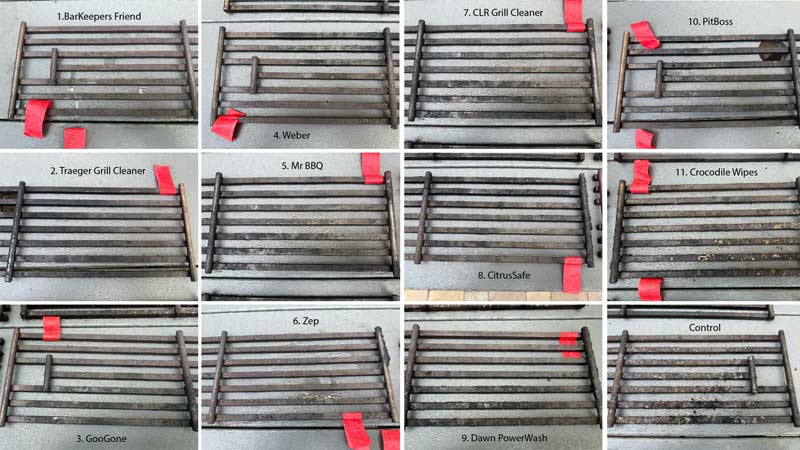
After rinsing them in the sink and letting them dry, we laid them out on the table to examine the results. Barkeeper’s Friend, Traeger, and Goo Gone took the top three spots, with Dawn PowerWash, Pit Boss, and the Crocodile wipes ranking in the bottom 3. It was no surprise that the Crocodile wipes came in last. The fibers of the cloth kept catching on the grime, and this just isn’t the kind of job that those are intended for.
Removing Burned-On Carbon
Our final test was the toughest. We wanted to see if any of these cleaners were more helpful than the others when it comes to softening up the burned-on buildup of our Weber Searwood XL heat deflector.
I started with the Weber plastic scaping tool first to get the easy stuff out of the way. Then I sprayed each cleaner on a different section of the deflector and allowed it to soak for 5 minutes before returning with a ScotchBright sponge and the plastic scraper.
Now, we agree with you; this test isn’t really fair. Obviously, some sprays were asked to clean a much dirtier section than others. So this isn’t a perfect test, by any stretch of the imagination, but we’ll still share what we observed.
The citrus cleaners did a great job of cleaning mild buildup; both the Zep and the Citrusafe sections got impressively clean, but they were both located on the far left end where there wasn’t as much buildup. Mr. Barb-B-Q had a much bigger job to do, and its citrus power didn’t seem to cut through nearly as well.
The Traeger spray went down on a pretty messy section right in the middle, and it appears as though it did a pretty good job breaking down the buildup. Goo Gone also had a bigger job to clean, and its foaming power did an impressive job breaking down the thick buildup as well.
And finally, the Crocodile cloth? Did any of us think this would be the right cleaner for breaking down burned-on carbon? Not in the slightest, but it did come in handy cleaning my hands and arms after I did all that messy cleaning.
Our Top Picks
So where does that leave us? Were there any clear winners or losers in this test?
Let’s start with the Crocodile wipes. We weren’t sure whether to even include them in this video because it’s just not comparing apples to apples, but is there still a reasonable application for these in your grill cleaning toolbox?
No, you’re not going to use these for cleaning the big jobs, but there are a lot of little messes along the way that these wipes would be perfect for. However, at 25 cents per wipe, wouldn’t it make more sense to get some Clorox or Lysol wipes instead since they only cost about 7 cents per wipe? Maybe. But the Crocodile wipes are much bigger and thicker. It takes more than 3 Lysol wipes to equal a Crocodile wipe, so now we’re closing the price gap a bit.
They are super convenient, and I would say the sweet spot for these would be if you’re taking a grill on the go, either tailgating, camping, or doing competition barbecue. Maybe you don’t have great access to a sink; I would 100% take a pack of these to clean hands as well as all the drips and mess that go with outdoor cooking.
For the sprays, I would say there were 3 that probably stood out the most for us.
The Dawn PowerWash Heavy Duty did a phenomenal job cleaning the exterior grime without leaving streaks. It easily handled messes other cleaners left behind. However, it didn’t handle the really burned-in messes on grill grates and heat deflectors as well as the rest.
The Traeger Grill Spray, on the other hand, did a surprisingly good job cleaning the grill grates and heat deflector, considering its runnier consistency, but it did leave some streak marks behind on the stainless steel.
The Goo Gone Grill and Grate Cleaner was our go-to cleaner going into this test, so I admit, I was a little biased, but prepared to discover something better. However, I guess there’s a reason why it’s been my go-to for a couple of years now. The thick foam really clings to the grime, giving it time to break down the mess, and it did pretty well in all the tests. Did it win by a landslide? No. But will it still be the one I buy after I finish using up these other 10 bottles of cleaner sometime in 2032? Probably. But who knows what new and fabulous cleaners will be available by then.
Quick Links to the products mentioned in this post:
- Barkeepers Friend Multipurpose Cleaner or Lowes or Walmart or Amazon
- Zep Heavy Duty Citrus Degreaser and Cleaner or Amazon
- Citrusafe BBQ Grill Cleaner or Lowes or Amazon
- Dawn PowerWash Heavy Duty or Amazon or Walmart
- Pit Boss Grill and Smoker Cleaner and Degreaser or Walmart
- Goo Gone Grill and Grate Cleaner or Walmart
- CLR BBQ Grill Cleaner or Walmart
- Traeger Grill Cleaner or Walmart or Amazon
- Weber Grate and Grill Cleaner or Lowes or Ace
- Mr. Bar-B-Q all-in-1 grill cleaner or Ace or Walmart
- Crocodile Cloth grill wipes or Amazon
- Nylon scrub brush
- Stainless steel scrubbie
- Microfiber cloths


Leave a Comment