


We bought the seven most popular steak knife sets on Amazon, and three were so disappointing that we threw them away when we were done. But before we did, nine people tested them blind, and we measured every blade scientifically to see which were actually the best steak knives.
Quick Links to the products mentioned in this post:
- Dalstrong Gladiator steak knife set (4)
- Wüsthof Gourmet steak knife set (4)
- Bellemain Steak Knife Set (4)
- Henckels Prime steak knife set (4)
- Cuisinart steak knife set (6)
- Amazon Basics knife set (8)
- Amorston steak knife set (8)
- Edge on Up BESS tester
Here at the Barbecue Lab, we test all the gear used in outdoor cooking to help you make educated buying decisions and avoid regret. Today’s battle is between steak knives, and we’ve called on some friends to help determine a winner. But first, let’s see which knives are in the running.
Amazon’s Best Selling Steak Knife Sets
We purchased all 7 sets of knives on Amazon a few weeks ago, and the prices we share reflect the prices that we paid at that time. We selected the steak knife sets that were best sellers at that time, curious to find out whether “best seller” actually means “best performer”.
- The Amorston Steak Knife set cost us $14.99 and includes 8 knives at $1.87 a piece.
- The Amazon Basics steak knife set cost us $24.98, and includes 8 knives at $3.12 each.
- We spent $19.95 on the Cuisinart set of knives, including 6 steak knives at $3.32 each.
- The Bellemain and Henckels steak knife sets both cost $27.99 for 4 knives, at $7 per knife.
- We spent $69 on the Wüsthof Gourmet knife set, including 4 steak knives at $17.25 each.
- And finally, the Dalstrong Gladiator steak knife set cost us $119 for 4 knives with sheaths at $29.75 per knife.
So with a price difference of $27.88 between the least and most expensive single knife, the question we wondered was whether our blind panel would detect that big of a difference in performance.

Blind Panel Best Steak Knife Testing
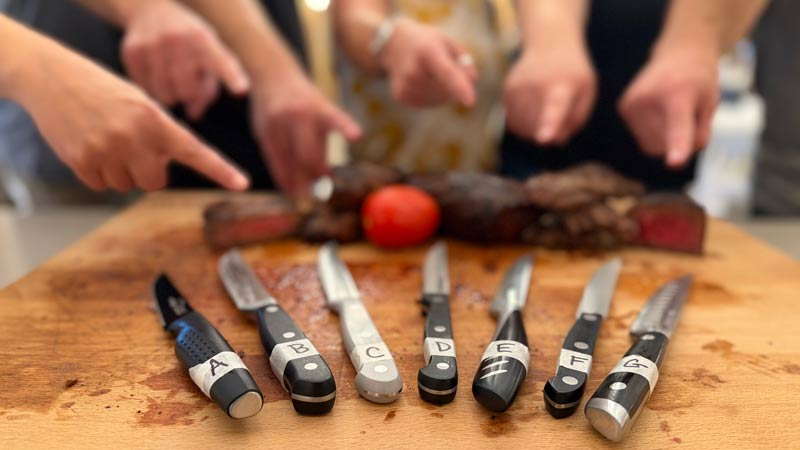
9 people answered the call for our free steak lunch at the Lab last week. We labeled each knife A through G and gave each guest a survey to complete.
One at a time, our guests stepped up to the cutting board to slice a Roma tomato, sirloin, NY strip, and skirt steak. We asked them to score each knife based on cutting ease, cleanness of cut, handle comfort, control and confidence, tomato skin penetration, and tomato slice quality. After testing all 7 knives, we asked our guests to pick a favorite and least favorite knife, not knowing anything about the price.
6 of our 9 guests unknowingly named the same knife as their favorite, and 5 of the 9 also named the same knife as their least favorite. The Dalstrong Gladiator was selected as the favorite, with the Wüsthof close behind. Most sharing a preference for the feel of the Dalstrong in their hand over the Wüsthof. When we asked everyone to name their least favorite knife, the Cuisinart was the clear loser.
After averaging all of our guests’ feedback, here are the rankings of our blind knife testing, with Dalstrong and Wüsthof neck and neck at the top, all the way down to the Cuisinart in last place.
Average Guest Rating
- Dalstrong Gladiator: 4.83
- Wüsthof Gourmet: 4.8
- Bellamain: 4.08
- Henckels: 3.91
- Amorston: 3.76
- Amazon Basics: 3.34
- Cuisinart: 2.76
Of course, it’s easy to pick your favorite when you don’t know the price. But would price make a difference for our panel?
Does Price Make a Difference?
After filling out their surveys, we sent each guest over to see the price-per-knife reveal and decide if that would change their answer and potential purchase decision. The price per knife was based on that day’s Amazon prices, which reflected a higher price on the Wüsthof than the price we paid.
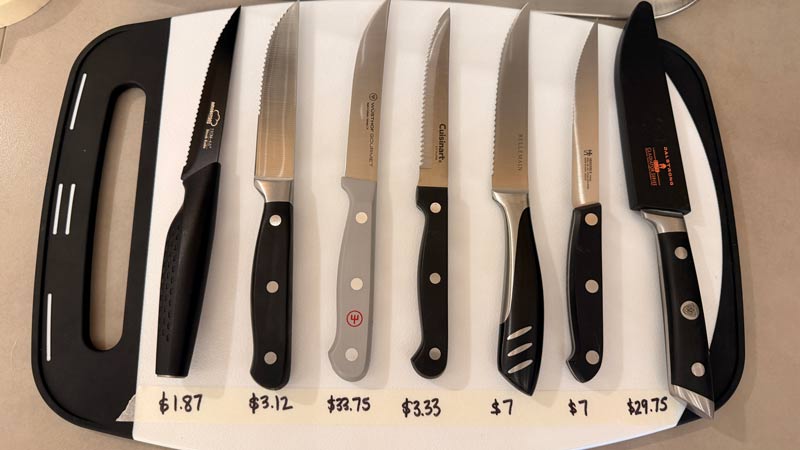
Of our 9 guests, 6 of them stuck with their first place selection even after learning the price, while 3 chose a more economical option, including the Bellemain, Henckels, and Amazon Basics.
In just a second we’re going to break out our $270 BESS sharpness tester to see how our scientific testing compares to the user experience, but first I want to pass a question off to you. For something like a steak knife, are you willing to pay more per knife for better performance, or is price the ultimate deciding factor? How do you decide? Drop us a comment down below and give us your thoughts.
BESS Sharpness Testing
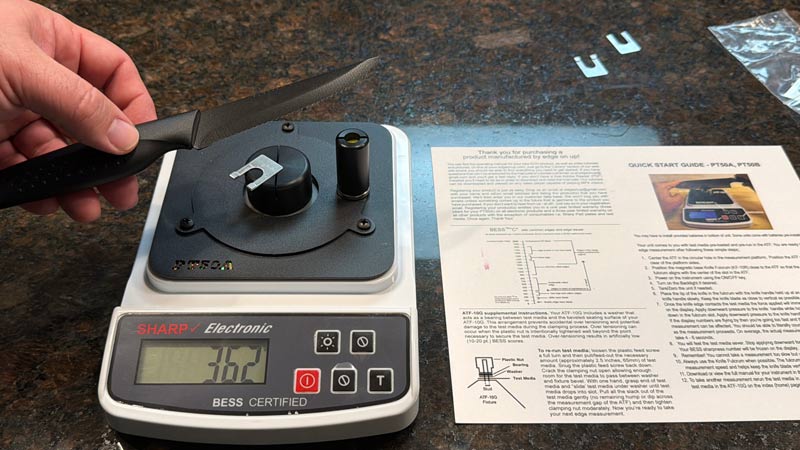
In an effort to be as objective and scientific as possible in this test, we ordered an Edge On Up BESS Tester. It measures knife sharpness by recording how many grams of force are required for the blade to cut through a standardized test filament; the lower the number, the sharper the edge.
We completed 3 rounds of testing for each knife and averaged the scores. And it turns out, the BESS confirmed what our guests already told us.
The Dalstrong was clearly the sharpest knife with an average score of only 140.5, and Wüsthof came close behind with an average of 186. The Amorston proved to be the least sharp with a Bess score of 343.5.
- Dalstrong Gladiator: 140.5g
- Wüsthof Gourmet: 186g
- Bellamain: 231g
- Amazon Basics: 235.5g
- Cuisinart: 256.5g
- Henckels: 282g
- Amorston: 343.5g
Conclusion: Our Picks for Best Steak Knife Sets
Alright, so where does all of that information leave us?
As far as user experience was concerned, the Dalstrong Gladiator steak knives were the clear winners. Their sharpness was closely matched with the Wüsthof Gourmet knives, but most agreed that the feel of the Dalstrong in the hand was superior, which was surprising given the variety of people on our panel. Though, without feeling them both side-by-side, I don’t think anyone would feel disappointed with the Wüsthof. I do like that the Dalstrong knives include sheaths for safe storage.
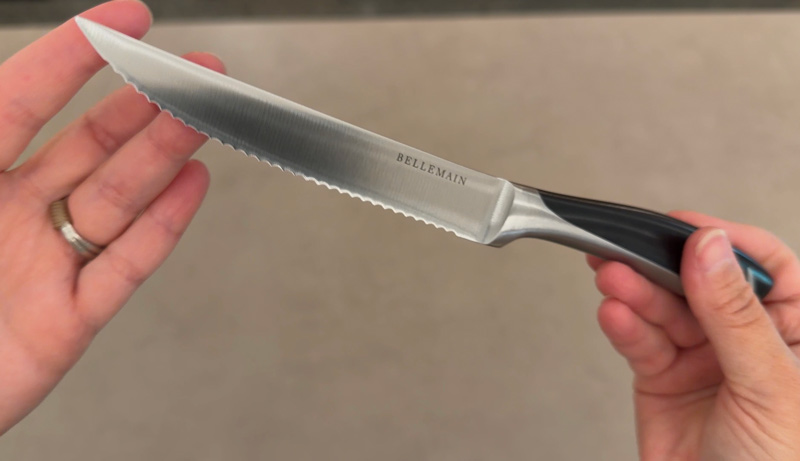
However, if we were just looking at the more budget-friendly options, I would say the Bellemain steak knife set was the best pick. It honestly had a hand feel reminiscent of the Dalstrong and scored the best among our guests, as well as the BESS Testing, compared to the other budget knives.
Melissa and I both completed the same testing as our guests and had a lot of the same thoughts. We don’t often tell you what NOT to buy, but there are three knives in this group that we highly recommend you pass on. The Amazon Basics, Cuisinart, and Amorston knives shredded the steak. It wasn’t good. The serrated edges just dragged on the meat, making it impossible to make a straight cut. I know the price looks appealing, but save yourself the struggle and just don’t.
Best Steak Knife Set Overall
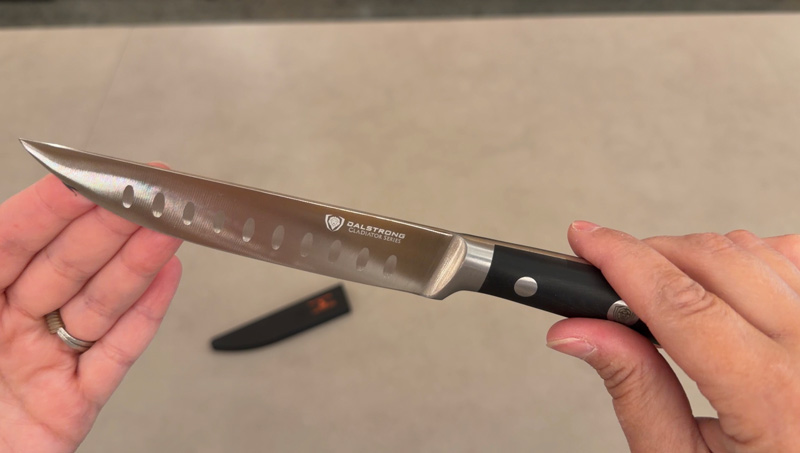
DALSTRONG GLADIATOR
- 4 knives in a set
- included sheaths
- Lowest (best) BESS sharpness scores of all the knives
- Highest guest average among blind testers
- Check current price
Best Budget Steak Knife Set
BELLEMAIN STEAK KNIVES
- 4 knives in a set
- Lowest (best) BESS sharpness scores of the more budget-friendly options
- Highest-ranked budget-friendly steak knife among the blind testers
- Check current price
Steak Knife FAQs
Are serrated or straight edge steak knives better?
For steak knives, we generally prefer a straight edge over a serrated knife. A straight-edge blade gives you a cleaner slice through the meat instead of relying on little teeth to saw back and forth. In our testing, that difference was pretty obvious. The straight-edge knives cut more smoothly, gave us more control, and did a better job slicing cleanly through steak and tomato skin. In fact, the three knife sets we disliked enough to throw away at the end of testing were all serrated.
That doesn’t mean a serrated knife has no place at the table. Serrations can stay usable for a long time because the teeth protect parts of the cutting edge from direct contact with the plate, and they can work well if you don’t want to think much about sharpening. But once a serrated steak knife starts feeling dull, it’s much harder to sharpen properly at home. A good straight edge will need maintenance eventually, but it’s easier to sharpen, easier to restore, and in our opinion gives you a noticeably better cutting experience. If we’re choosing a steak knife set for our own table, we’re going straight edge.
Are steak knives dishwasher safe?
Some steak knives are labeled dishwasher safe, but our household rule is simple: all kitchen knives are hand wash only, no matter what the packaging says. Even if the blade is made from rust resistant stainless steel, the combination of high heat, harsh detergent, and prolonged moisture inside a dishwasher can be hard on both the blade and the handle material over time. That’s especially true for knives with wood handles, but even metal or synthetic handles can take a beating from repeated dishwasher cycles.
Hand washing also helps protect the edge itself. Knives can knock against silverware, plates, or the dishwasher rack, which can dull or damage the blade long before the steel actually shows signs of rust. So while some manufacturers may technically call their steak knives dishwasher safe, we still recommend a quick hand wash, dry them right away, and put them back in storage. It takes an extra minute, but it’s the easiest way to keep a good set of steak knives looking and cutting their best.
What handle material is best for steak knives?
There isn’t one handle material that automatically makes a great steak knife, because comfort and control matter just as much as what the handle is made from. Pakkawood handles are a popular choice because they give you the warm look and feel of wood while being more durable and moisture resistant than traditional wood. Plastic handles can be more lightweight and affordable, while stainless or other metal handles often have a more sleek, modern style. Higher-end knives may also use other premium materials, but price alone doesn’t guarantee a better experience.
What matters most is the grip and how the handle feels in your hand. We tend to prefer ergonomic handles that feel secure without being bulky or awkward, especially when you’re cutting through a thicker steak. A beautiful handle may look great on the table, but if it’s slippery, too heavy, or uncomfortable after a few cuts, it’s not doing its job. For us, the best handle is the one that balances durability, comfort, and style without getting in the way of the knife itself.
What is “full tang construction”?
Full tang construction means the steel from the blade continues all the way through the length of the handle instead of stopping partway inside it. You can often see the tang as a strip of metal running between the handle scales, although some designs hide it.
In general, a full tang gives a knife more strength, durability, and balance, which is why it’s common on better kitchen and steak knives. It isn’t the only sign of a quality knife, but it’s usually a good indicator that the knife was crafted to hold up to years of regular use.
How often should steak knives be sharpened?
There isn’t a set schedule for sharpening steak knives; the better rule is to sharpen them when they start feeling dull or require more sawing and pressure than they used to. How often that happens depends on the blade materials, how frequently the knives are used, and their edge retention.
Stainless steel is common and easy to maintain, while high carbon stainless steel often holds a sharp edge longer. Decorative finishes like Damascus steel don’t automatically determine how often a knife needs sharpening, since the actual cutting performance still comes down to the steel and edge underneath.
Between sharpenings, honing can help realign a slightly rolled edge, but honing does not actually remove enough metal to restore a truly dull blade.
When it is time to sharpen, you can use a pull-through sharpener, a whetstone or sharpening stone, an electric sharpener, or have the knives professionally sharpened. Some knife block sets also include a built-in sharpening system, which can make routine maintenance easier.
Serrated knives are a different story. Once the teeth start to lose their bite, they’re much harder to sharpen correctly at home, and for most inexpensive steak knife sets, it’s usually more practical to replace them than trying to restore the edge.


Leave a Comment