


A few years back, we tested the best instant-read thermometers we could find, and frankly, not much had changed until now.
Today we’re seeing claims of instant-read thermometers that reach a full reading in as little as 0.1 seconds, but can that actually be true or is it all just a steaming pile of marketing lies?
One of the leaders in the space Thermoworks, has retired the Thermapen ONE and replaced it with the new 0.4-second Thermapen Nano. TempPro now offers the Lightning that claims full readings in 0.1 seconds, so we’re bringing back the best competitors from our last test, adding the strongest newcomers, and finding out whether anyone has moved the instant read thermometer goalposts.
Quick Links to the products mentioned in this post:
- Thermapen Nano
- TempPro Lightning TP622 or Amazon
- Fireboard Spark
- Typhur InstaProbe Core (Save 10% with code: THEBBQLAB) or Amazon
- ChefsTemp Finaltouch X10 or Amazon
- Thermoworks Sizzle
- Reference Thermapen
Here at The Barbecue Lab, we test the equipment of the outdoor cooking world, so if you want to know the best gear, you’re in the right place. In this article we will test the speed and accuracy while registering temperatures at 4 different points ranging between 32 degrees all the way up to 194 degrees, see if any of them planned for left handed users, test if any of them are truly waterproof, compare the brightness of the displays and a whole lot more, so let’s see what models we’re working with.

The Instant Read Thermometers We Tested
Coming in at $40, we have the TempPro Lightning TP622, also known as the TempSwift Pro. Costing $55, we have the ChefsTemp Finaltouch X10. The Thermoworks Sizzle and the Typhur InstaProbe Core both cost $59. We take a decent jump in price now to the brand new Thermoworks Thermapen Nano, coming in at $119. And the most expensive in this test is the FireBoard Spark, costing $149.
These meat thermometers have either been sitting around the Lab from previous tests where they were sent by the manufacturer or were purchased by us, but we’re going to treat all thermometers the same. Nobody sent notes or gets special treatment. The tests are the tests and the results speak for themselves, so if straight forward testing that lets the data speak is for you, let’s dive in.
Speed and Accuracy Testing
If there’s 1 thing that everyone wants to see in an instant read thermometer test, it’s how fast it registers temperatures. If there’s a second test, it’s making sure it’s an accurate thermometer instead of just fast. Because when it comes to food safety, a fairly accurate thermometer might just not be good enough.
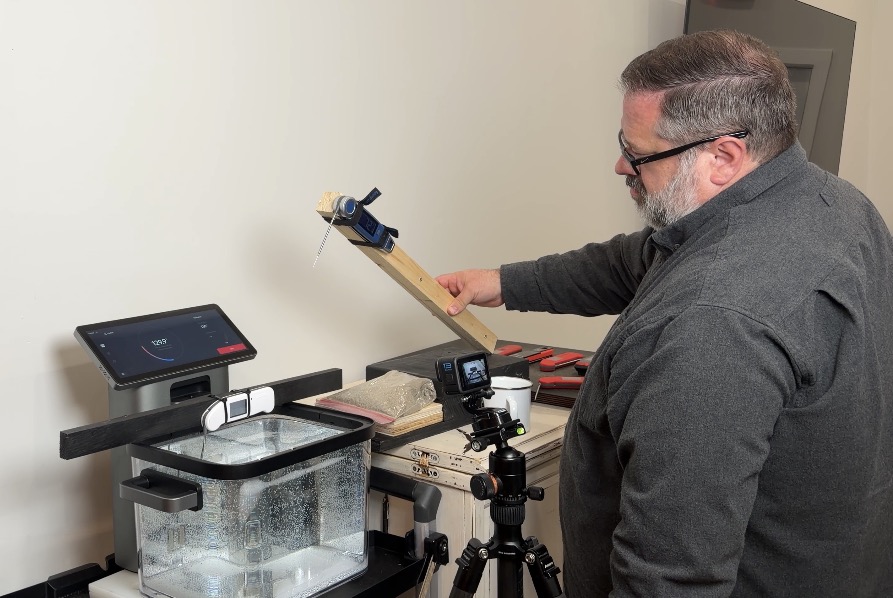
To test both of these, we brought our instant-read thermometer testing rig out of mothballs and fired up the Typhur Sous Vide machine. We’re testing in a circulated water bath since that’s the way thermometer companies test speed and accuracy. It’s repeatable and it’s consistent.
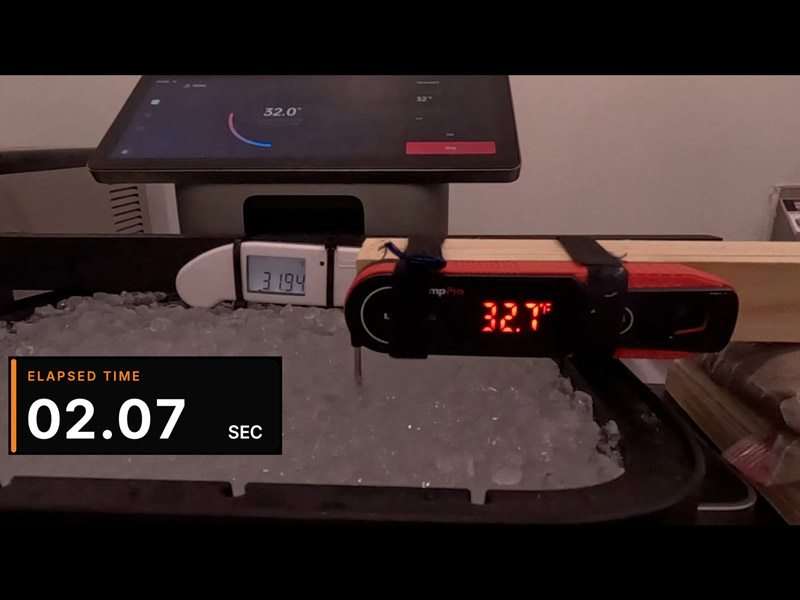
Time to Measure 32°
We started with an ice water test, since 32° is the calibration point. We filled the reservoir with nugget ice and set the Typhur Sous Vide to circulate the ice water at 32°. We placed a Thermoworks Reference Thermapen in the bath to confirm the bath temperature for every test. Each digital instant read thermometer took 5 readings within one degree of the reference thermometer, and we tracked the time to the hundredth of a second for each. We threw out the two slowest readings and averaged the top 3 fastest times for each instant read thermometer.
- The Thermapen Nano had an average time of .57 seconds.
- The Fireboard Spark had an average time of 1.09 seconds.
- The TempPro Lightning had an average time of 1.89 seconds.
- The ChefsTemp FinalTouch X10 had an average time of 2.37 seconds.
- The Typhur InstaProbe Core had an average time of 2.39 seconds.
- The Thermoworks Sizzle had an average time of 3.27seconds.
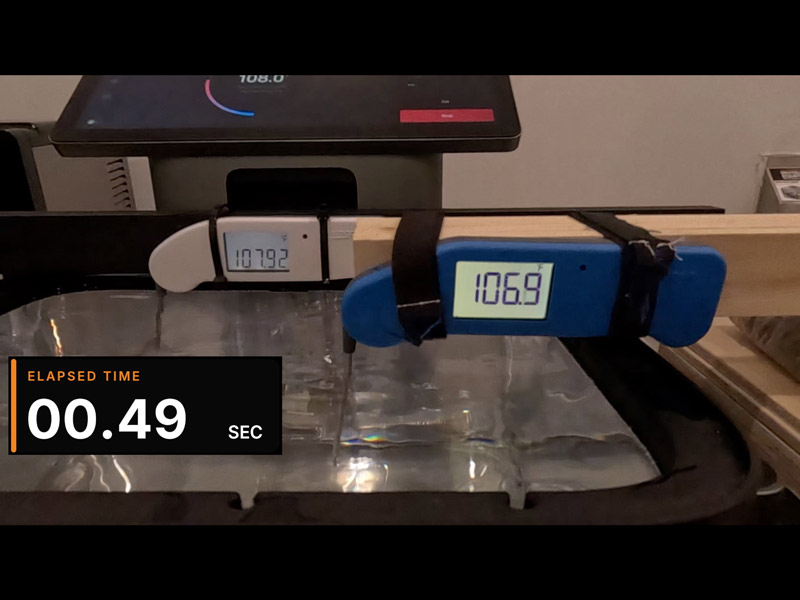
Time to Measure 108°
32 degrees Fahrenheit is 38 degrees below a room temperature of 70 degrees, so next we went up 38 degrees to 108 degrees to see if we saw changes in performance. In this test, the Lightning improved by a whole second over its performance in the ice bath.
- The Thermapen Nano had an average time of .53 seconds.
- The TempPro Lightning had an average time of .57 seconds.
- The Fireboard Spark had an average time of .85 seconds.
- The Thermoworks Sizzle had an average time of 1.32 seconds.
- The Typhur InstaProbe Core had an average time of 1.69 seconds.
- The ChefsTemp FinalTouch X10 had an average time of 1.7 seconds.
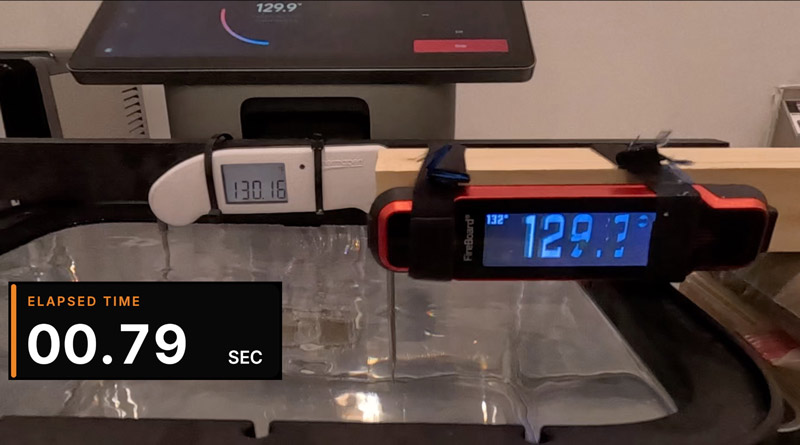
Time to Measure 130°
While reference temperatures are fun, I wanted to see these digital thermometers perform at the temps I’ll usually put them to work. A medium rare steak is around 130 degrees Fahrenheit, so that was our next target. We again dropped each instant read thermometer 5 times, averaged the fastest 3 times and saw the Fireboard Spark come in first place.
- The Fireboard Spark had an average time of .70 seconds.
- The TempPro Lightning had an average time of .79 seconds.
- The Thermapen Nano had an average time of .90 seconds.
- The Typhur InstaProbe Core had an average time of 1.58 seconds.
- The Thermoworks Sizzle had an average time of 1.62 seconds.
- The ChefsTemp FinalTouch X10 had an average time of 1.88 seconds.
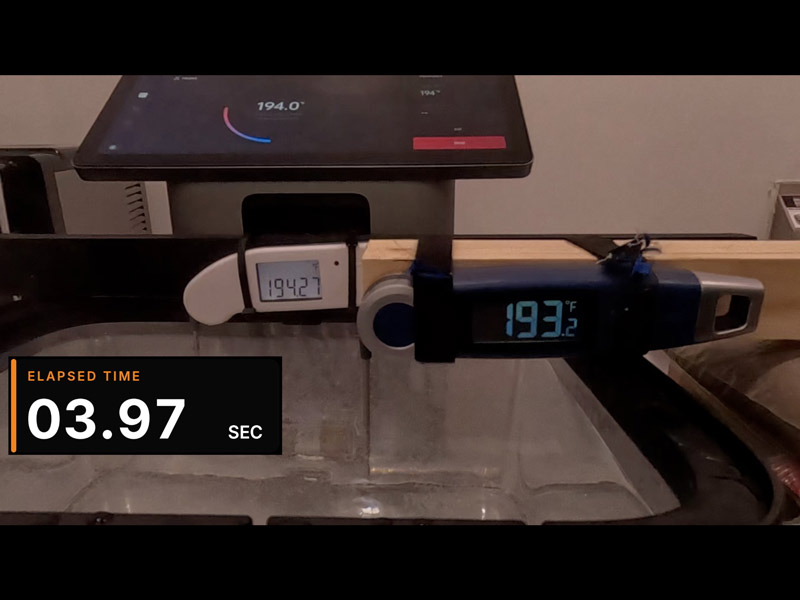
Time to Measure 194°
For the final accuracy and speed test, we turned the Typhur Sous Vide up as high as it would go which is 194 degrees Fahrenheit. I’m using meat thermometers in this temperature range when cooking briskets and pork butts, so we’ll call this the brisket temp test, or as close as I could get to it with the gear we have. In the previous tests, we were just going 38 degrees away from room temperature for the first two and 60 degrees away for the second. For this test, we’re going 124 degrees higher than room temperature, so with that much of a temperature change, things are guaranteed to slow down a bit.
- The Fireboard Spark had an average time of 1.29 seconds.
- The Thermapen Nano had an average time of 1.52 seconds.
- The TempPro Lightning had an average time of 1.94 seconds.
- The Thermoworks Sizzle had an average time of 2.01 seconds.
- The Typhur InstaProbe Core had an average time of 2.2 seconds.
- The ChefsTemp FinalTouch X10 had an average time of 6.5 seconds.
Are the Manufacturer’s Accuracy Claims Really Marketing Lies?
With 4 tests for accuracy and speed, completed, what exactly do the manufacturers claim the speed and accuracy to be? Here’s a chart of the published stats from each brand, and can I highlight a few things?
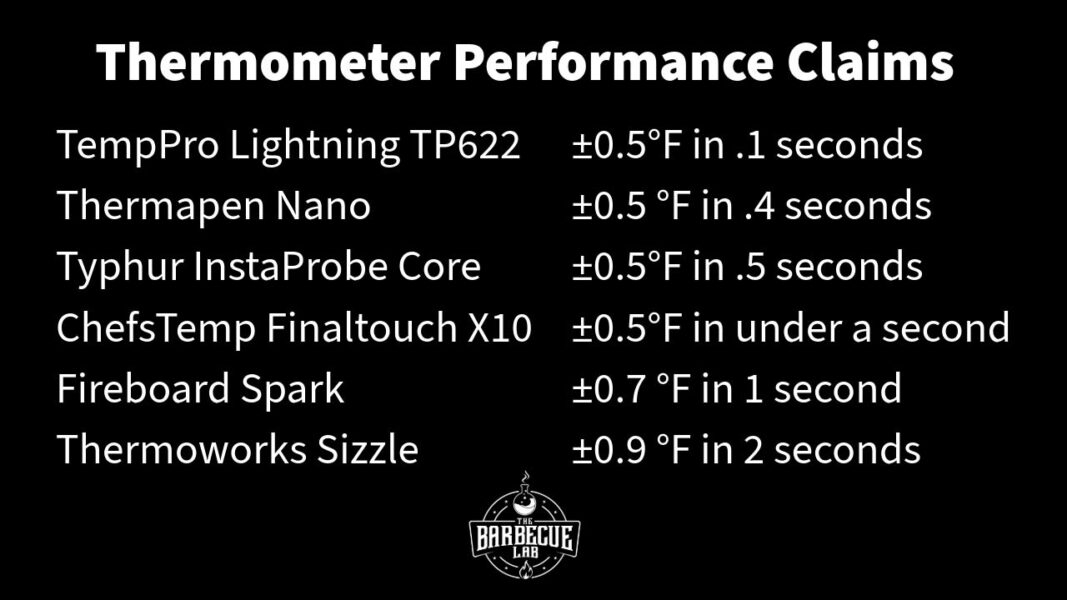
The Thermoworks Sizzle claims a reading in 2 seconds, which is the most honest claim in the group I think. It achieved it most of the time, and I’m good with that claim.
The ChefsTemp claims half a degree accuracy under a second, but our tests debunked that. We didn’t see a single time where the ChefsTemp thermometer read within one degree under a second, let alone half a degree under a second. I would be interested to see their tests behind that claim.
The Fireboard Spark and the Thermapen Nano were both relatively close to stated accuracy when we measure to within one degree. We recognize that this is a testing rig built out of wood using a baggie of sand as the stopping cushion. We’re not claiming this as 100% accurate scientific testing, but rather the best we can do on the YouTube budget we have.
The instant read thermometer I do really have an issue with their claims though is the TempPro Lightning. Let’s read from their website, shall we? “Fast & Accurate: Enjoy speed and precision by receiving full readings in just 0.1 seconds with a Pro-Accuracy of ±0.5°F.”
0.1 seconds, huh? Apparently there’s no regulation authority on claims for accuracy and speed, and as consumers, we need to be aware of that. Ok, rant over.
User Experience Tests
Digital Display
Now that we’ve tackled performance, let’s shift gears to the features and experience.
Resolution
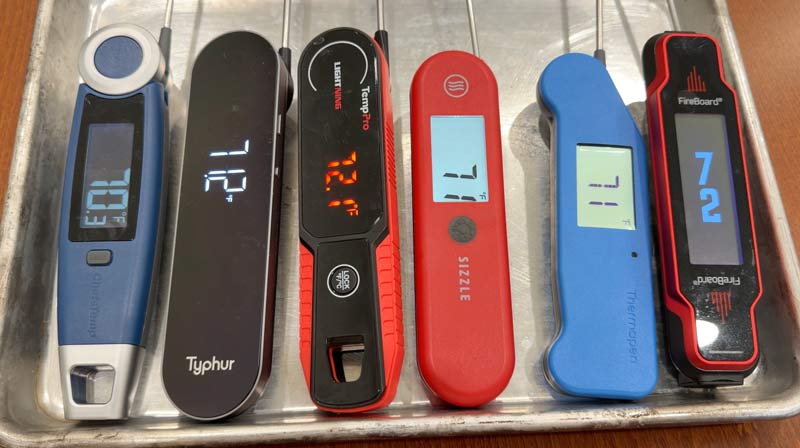
You probably noticed in our temperature tests that all of the instant read thermometers were measuring temperature to the tenth of a degree. Now, I don’t know about you, but I don’t generally need to measure my internal temperatures that specifically, and I find the additional digits to be more of an annoyance. However, this is the default and only setting for 3 of the 6 thermometers.
Only the Thermoworks and Fireboard instant read thermometers have the ability to switch to the whole degree. And while we’re at it, all 6 meat thermometers are set to Fahrenheit out of the box, but have buttons to switch to Celsius if that’s what you prefer.
Automatic Backlit Display
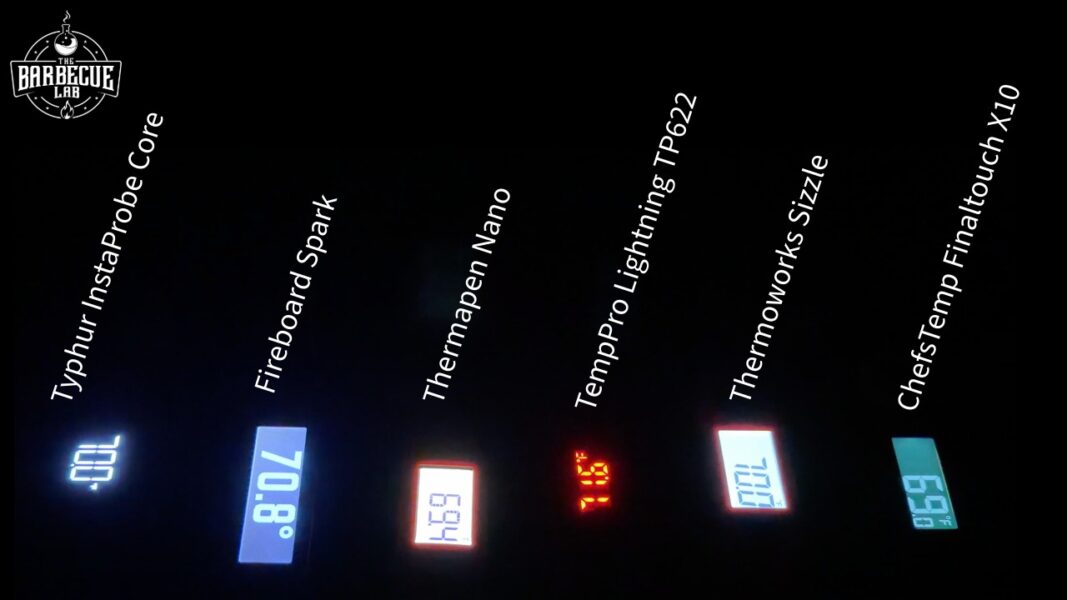
I want to take a minute to explore and compare the backlights on these meat thermometers. They all have decent backlit displays, though I would say the ChefsTemp is the dimmest. The group’s variety really comes down to preference; do you prefer red on black, white on black, black with backlight, and so on.
Something to note however, is that the Fireboard Spark gives the user some control over how the backlit screen works. It has an adjustable display where you can control the brightness and contrast as well as invert the screen. I personally lean toward the Thermapen Nano display as it’s much brighter than the Thermapen One display, and it’s easy to read when I’m measuring in a dark grill.
Auto Rotating Screen
Probe and display rotation is one area where we see some differences in these models.
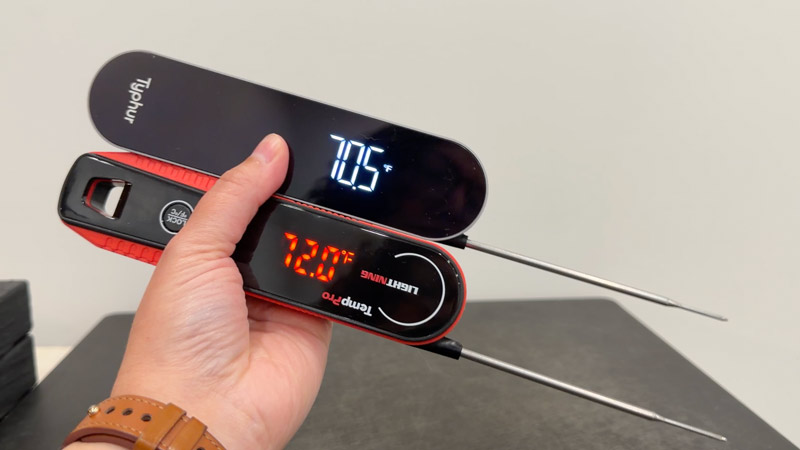
The TempPro Lightning and Typhur InstaProbe both have rotating probes that extend up to 180° with a display that also rotates 180°.
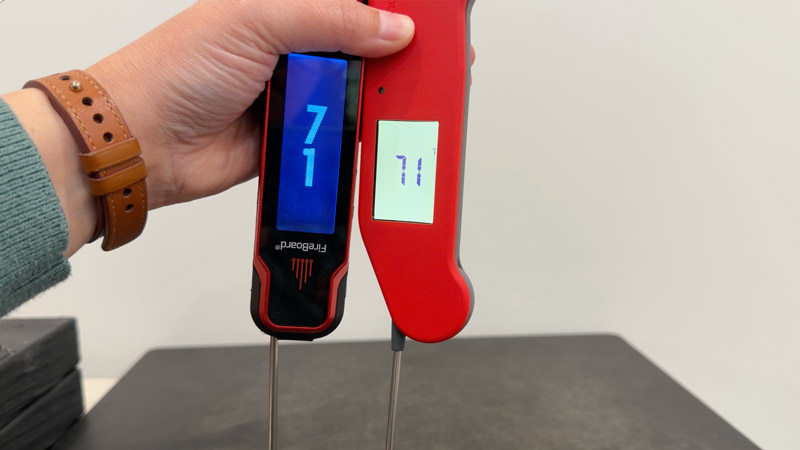
The Thermapen Nano and Fireboard Spark both have probes that extend 180°, but their displays both rotate 360°.
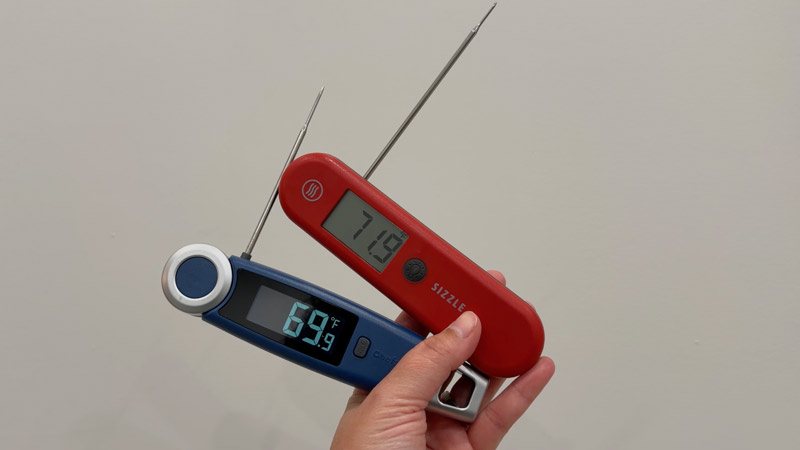
The ChefsTemp X10 and Thermoworks Sizzle thermometer’s probes both extend 270°, while their displays rotate 180°.
Neither Melissa nor I are left-handed, but we called Melissa’s brother Matt, who is a lefty, and he explained that he found the 360° rotating display to be more valuable than the 270° probe extension. If you’re a lefty, sound off in the comments below and tell us your thoughts. Which of these meat thermometer orientations would you prefer?
Automatic Sleep
All of these models have an auto-wake function that turns the instant read thermometer on when the probe is opened and off when the probe is closed.
If the probe is left in the open position, the Typhur InstaProbe Core automatically turns off after 30 seconds, the TempPro Lightning and Fireboard Spark will auto-shut off in 90 seconds, the ChefsTemp FinalTouch turns off in 3 minutes, and the Thermoworks thermometers are both adjustable. The Sizzle can be set to turn off after 30, 60, 120 seconds, or not at all, while the Nano is adjustable between 10 and 180 seconds.
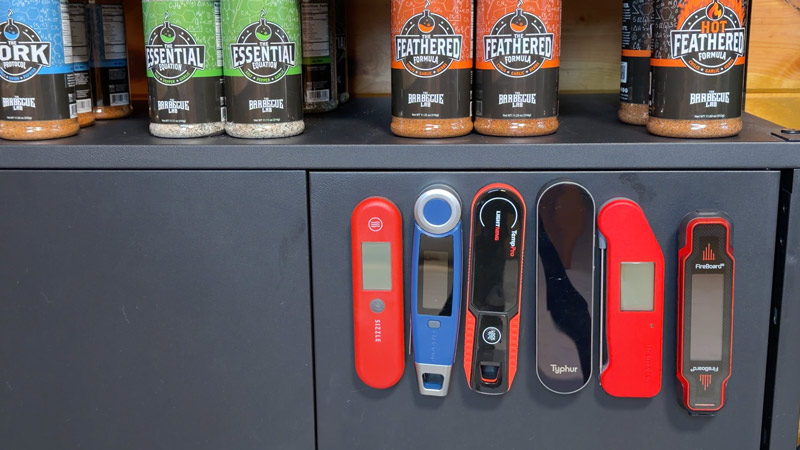
Built-in Magnets
All 6 of these instant-read thermometers have built-in magnets on the back for convenient storage. We found them all to be pretty decent, however the magnets on the TempPro and ChefsTemp were the weakest and most prone to being knocked off if bumped the wrong way. The rest of them appeared to have stronger magnets that could hold up to most bumps and wind just fine.
Water Resistance
All of these meat thermometers are water resistant, but we have two different ratings represented here, so let’s talk about what that means.
The ChefsTemp, Typhur, TempPro, and both Thermoworks thermometers all boast IP67 ratings, meaning they can be submerged in water for up to 30 minutes. So if they fall in a sink of water, you shouldn’t have any issues.
The Fireboard Spark is the only instant read thermometer with a rating of IP66, meaning you can run it under water to wash, but it shouldn’t be submerged. The Spark has a valid reason for this limitation however, and I guess now is as good of a time as any to explore it.
Fireboard Spark’s Bonus Feature
While all of these meat thermometers have a stainless steel folding probe that can instantly read internal temperatures of food, the Fireboard Spark has a super power unique from the rest. In the end of this thermometer is a port for plugging in a wired probe.
In addition to being a digital instant read thermometer, the Spark can also host a leave-in thermometer which sends temperature data to the Cloud where you can view and monitor long cooks from the Fireboard app. I’m not going to go super in-depth on that here, but if you’d like to learn more about that feature, you can check out our full review of the Spark meat thermometer from a couple of years ago.
Lock Feature
If you’re the kind of instant read thermometer user who likes a lock or hold feature, 4 meat thermometers have that ability. ChefsTemp and TempPro both have a button on the front, while the Typhur’s button is on the side.
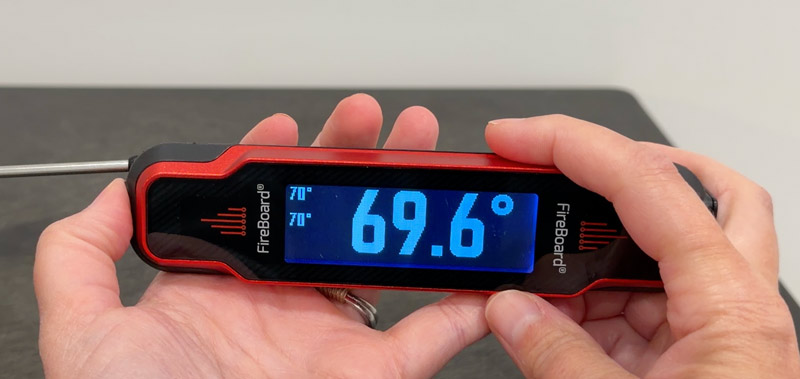
The Fireboard Spark actually does this automatically. As soon as it reaches a full reading, the thermometer gives a slight haptic buzz and shows the reading with a small number on the left of the display. It also saves the 3 most recent readings.
Neither of the Thermoworks instant read thermometers have this feature, which got me curious.
It seems to me that a dedicated hold button is much more common on inexpensive meat thermometers. And I think that’s partly because it’s solving a problem that better thermometers don’t have as often. If it takes several seconds for the temperature to settle, being able to lock that number before I pull my hand out from a hot grill is actually pretty handy. But when the instant read thermometer gets me to a stable reading this quickly, I don’t really need to freeze the display. I’ve already seen the answer.
And FireBoard takes a completely different approach. Instead of asking me to press a hold button, Spark recognizes when it’s taken a reading and automatically saves it.
I guess the question is: are you ever taking temperature readings in a hard-to-reach location where you might not be able to see the display while the temperature is being captured? I’ve just never really been a hold-button user, but I do like the way the Spark saves my last few readings.
Best Instant Read Thermometer Results
We’ve covered a LOT of ground on the best meat thermometers on the market today, and I have some final thoughts.
First, the ChefsTemp FinalTouch X10, Typhur InstaProbe Core and the Thermoworks Sizzle scored in the bottom three for almost all of our tests. We could go into more, but I think I’ll just leave it at that.
The TempPro Lightning, Thermapen Nano, and Fireboard Spark were our top 3 winners in all of our speed tests. So let’s break it down who each digital thermometer would be best for.
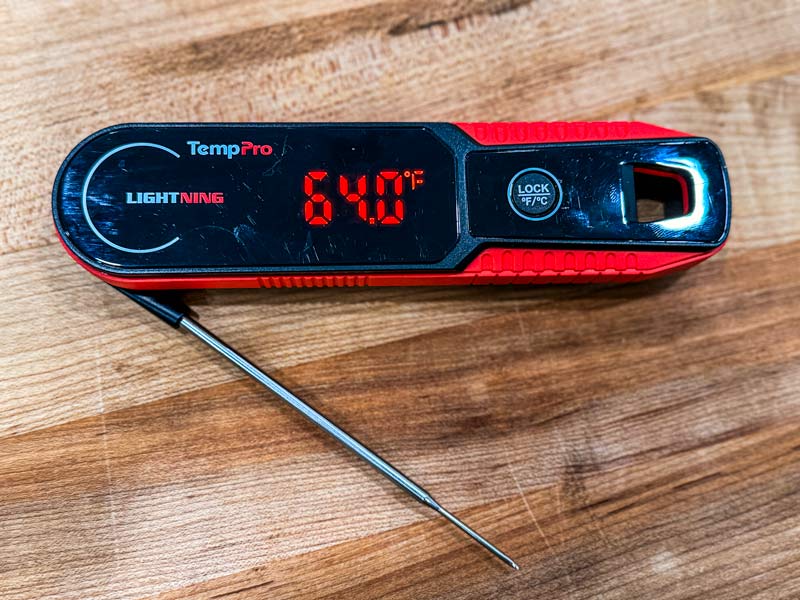
Best instant read thermometer under $40
The TempPro Lightning was surprisingly fast for that price point. However, the overall quality and features fall significantly below the more expensive options. For anyone buying an instant read thermometer where an affordable price is more important than longevity, the TempPro makes the most sense.
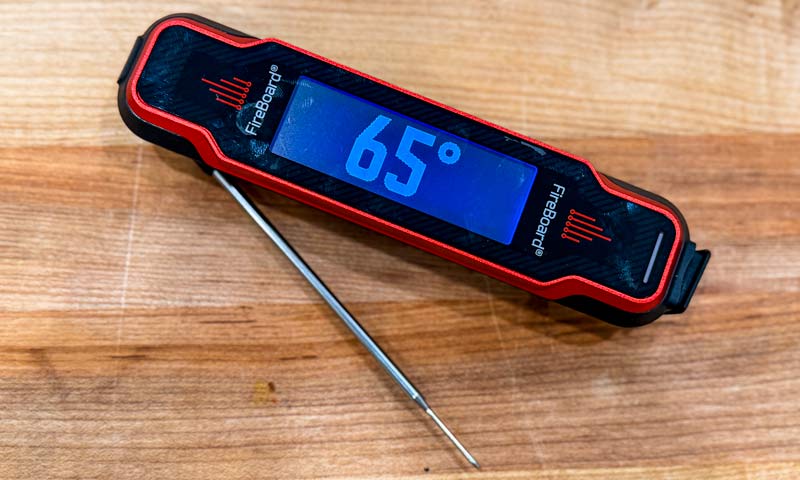
Best Multi-Use Thermometer
The Fireboard Spark is the most expensive thermometer in this comparison, and for good reason. With the addition of an external probe, it can solve your temperature monitoring for long cooks, in addition to the quick internal temp checks at the grill. The display refresh rate bothers me, however it is consistently fast so we’ve got to give this instant read thermometer credit where credit is due.
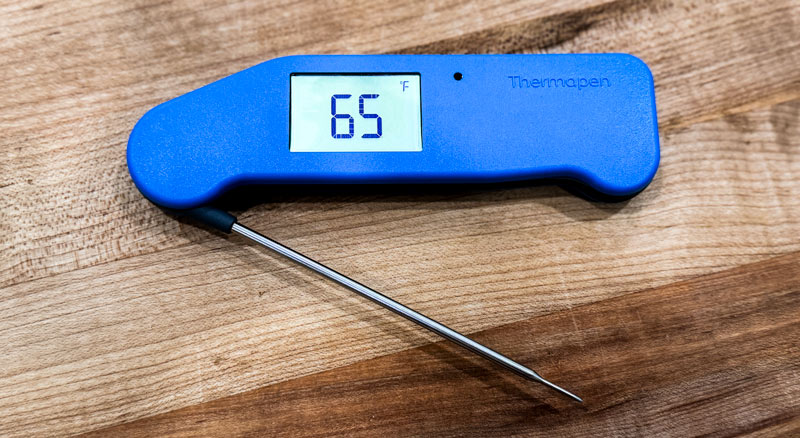
Best Instant read thermometer Overall
My favorite instant read thermometer of the group is the Thermapen Nano. It’s probably something where you have to put them all in your hand to understand, but the Thermapen just feels better, providing a secure grip. It had the fastest temperature readings average of the group. The feature set is robust and I have confidence in the longevity and durability of this product. Thermoworks Customer Service is top notch.
Quick Links to the products mentioned in this post:
- Thermapen Nano
- TempPro Lightning TP622 or Amazon
- Fireboard Spark
- Typhur InstaProbe Core (Save 10% with code: THEBBQLAB) or Amazon
- ChefsTemp Finaltouch X10 or Amazon
- Thermoworks Sizzle
- Reference Thermapen

Leave a Comment