


The Thermapen One has been the measuring stick for all other instant-read thermometers for 5 years, but today marks a new chapter. Thermoworks has officially announced their new Thermapen Nano as a replacement for the Thermapen One, and today we are putting it to the test to see if the claims they make about it are true. We’re going to test the speed of the Thermapen Nano and see if it can really get accurate temperature readings in 4/10 of a second, as they claim.
Quick Links to the products mentioned in this post:
We’ve been hands-on with a pre-production version of the Thermapen Nano for a couple of months now, and it turns out testing a meat thermometer this fast takes a whole lot more than we bargained for, but I’m getting ahead of myself. Let’s start with a tour around the Nano, and then we’ll get nerdy with the testing.

What’s different about the Thermapen Nano?
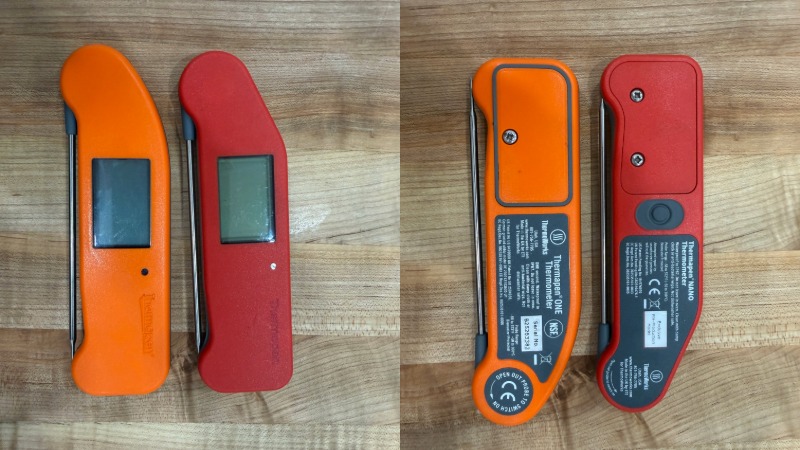
The new version of the Thermapen looks very similar to the Thermapen One, but a couple of things stand out right away.
- First, the Thermapen Nano is thinner than the Thermapen One, and you can feel the difference in the hand. It’s not dramatically thinner, but you can see it and feel it.
- The shape is still overall the same as previous versions, so no major departure there.
- The probe rotation is 180 degrees like the Thermapen One, and things on the front just look very similar.
- If you flip it over, here’s where things start to look a little bit different. The first thing that sticks out is the button on the back. This changes from Fahrenheit to Celsius, as well as allows you to change settings with a longer button hold. You can change from single degrees to adding the tenth of a degree, change rotation from 360 degrees to 180 degrees or just lock in a single display orientation and edit the sleep timer with just a single button.
- The battery compartment adds a second screw and ditches the gray surround in this new model (or at least the pre-production model, which will apply to everything we’re showing you here, so just remember that.)
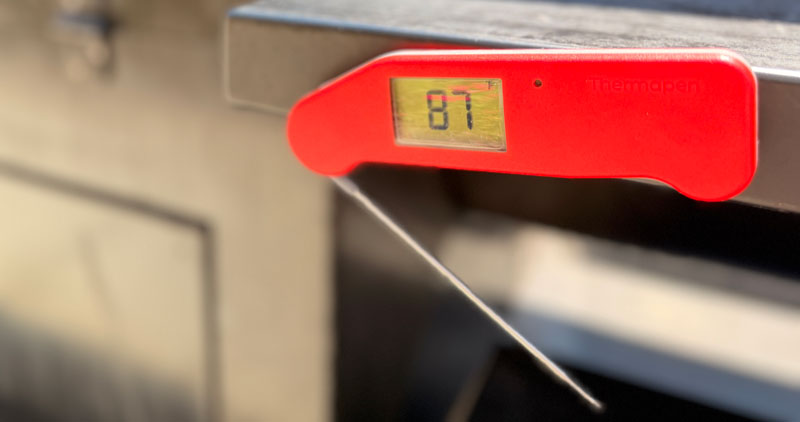
- One change that you can’t see here is this…. Yes, the Thermapen finally has a magnet, so sticking this to your grill during a cook is now something you can do without hot-gluing a magnet to the back.
- Thermoworks claims that the new Nano can get accurate temperature readings in .4 seconds, and since we just built a testing rig for our cheap thermometer roundup, it’s time to set it up and see if we can replicate Thermoworks’ results.
How We Tested the Thermapen Nano Instant Read Thermometer
Our Testing Rig
The ice bath test has long been used as the right way to calibrate a thermometer, so it’s a great place to start for both accuracy and speed.
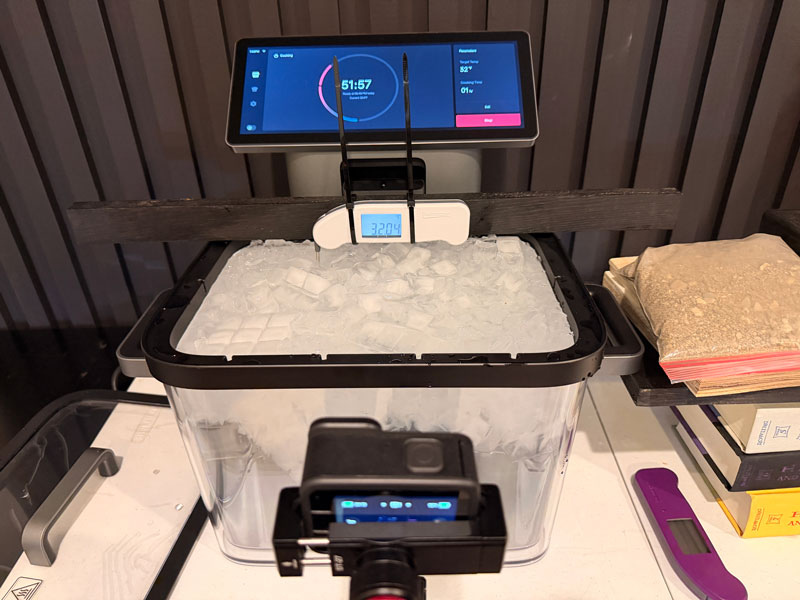
We’re using the Typhur Sous Vide Station in this test because it is an immersion circulator (basically a moving water bath), but it also has the ability to maintain ice-assisted cool temperatures. Every other sous vide I’ve used is just a heater and a pump, but for the short time they made it, this was the king of sous vides.
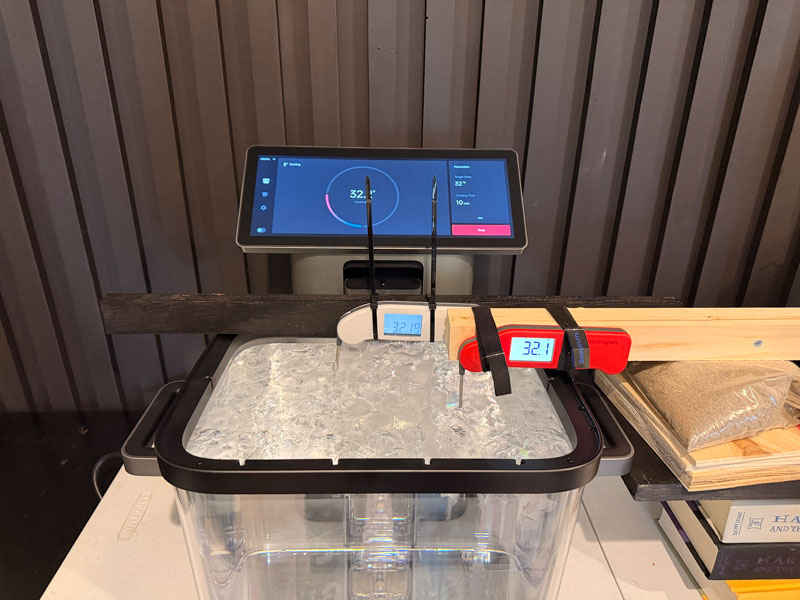
We filled the reservoir with ice, added cold water, and set the bath to 32° F. Once the bath achieved 32 degrees as measured by the white Reference Thermapen strapped to the background, we velcroed the Thermapen Nano to the drop arm, and were blown away with what we saw.
Thermoworks says that this new Nano instant-read thermometer is accurate to within 1 degree in .4 seconds, meaning that we need to see 33 degrees on the display to stop the test. We never saw anything BUT 33 degrees. It was seemingly immediately 33 degrees.
To measure the accuracy of their claims, we’re going to have to get a LOT more complex in our measurement.
How We Measured the Results
To understand the variables that we’re up against, we made a list.
- Uniformity of the bath – how even is the temperature of the water across the entire bath
- Stability of the bath – how stable is the bath and does it fluctuate in temperature?
- Flow of the bath – is the water moving, and how does that affect the temperature
- Insertion Rate – how fast can we insert the instant read thermometer
- Insertion Depth – we need to submerge as much of the probe as possible to prevent heat piping
- Display refresh rate – how fast does the display update when it reads a change to the temperature on the Thermapen Nano
- Camera refresh rate – how many frames per second are we shooting in on the camera
- Video editing rate – how many frames per second are we shooting the final video in, and how long does a single frame of footage represent in the way we’re shooting it
As long as we get all 8 variables right, we should be able to measure accurately, and any discrepancy gives us a margin of error per variable.
Does your head hurt yet? I know mine has for weeks now trying to get a hold of this. The good news is that here’s what we figured out.
We’re shooting these tests with a GoPro 13 Black, which will shoot in 240 frames per second. We’re shooting this video in 24p, which means that our high-speed footage needs to be run at 10% speed in order to utilize every frame of video we capture. The video frames are 4.17 milliseconds in length, and 100 milliseconds is equal to 1 tenth of a second, meaning that 1,000 milliseconds equals 1 second.
All of that means that we’re measuring speed by counting frames of video, so what you’re going to see is the complex calculation of frames to milliseconds to final results for all of our upcoming tests.
Buckle up, and let’s get to the results.
Ice Bath Testing
We ran the ice bath test 3 times, and the first time we got 73 frames, the second was 58 frames and the third was 69 frames, for times of:
- 73 = 304ms
- 58 = 241ms
- 69 = 287ms
That’s a precise reading time of .30, .24, and .28 seconds for the Ice Bath Test, well faster than the stated spec of .40.
Medium Rare Steak Test
For our second temperature target, we chose a medium rare steak temperature at 130 degrees.
We get asked in the comments why we test in water baths instead of using actual meat, and it’s because that’s the way all of the manufacturers test, using immersion circulators.
Testing in actual meat is a guessing game, since any part of the steak is going to be a different temperature. The outside is going to be further along, and the middle is going to be behind, and it’s a constantly moving target, so pretty much impossible to do any meaningful testing with real meat. Sorry to disappoint those who like to fill our comment section.
The first drop was 106 frames, the second was 114 frames, and the third was 112 frames for times of:
- 106 = 442
- 114 = 475
- 112 = 467
That’s a precise reading time of .44, .47, and .46 seconds for the mid rare test, just over the stated spec of .40.
Brisket Temp Test
The third target temperature is as close to a finished brisket temp as we can get in the immersion circulator. This particular model will go up to 194 degrees, so that’s where we’ll call “finished brisket” for this video. The first drop was a whopping 307 frames, the second was 199 frames, and the third was 175 frames for times of:
- 307 = 1.28
- 199 = 829
- 175 = 729
That’s a precise reading time of 1.28 seconds, .82 and .72 seconds for the brisket temperature test. Not exactly the .40 spec, but why would it be slower at 195 degrees than it is at 130 degrees? Why is it the fastest at 32 degrees?
I think this has to do with the range we’re asking the instant-read thermometer to cover between room temperature and the temperature we’re trying to read. We measured these times indoors where the thermostat was set to 70 degrees, so it needs to go down 40 degrees to hit 32, it needs to go up 60 degrees to hit 130, and it needs to go up 125 degrees to hit the brisket temp.
Maybe you have a different idea, but let us know down in the comments below, and let’s discuss.
How does the Thermapen Nano compare to the Thermapen One?
Now, I know that you’re probably asking the same question Melissa and I were asking. How does it compare to the Thermapen One that the Nano is replacing?
We ran the same tests, and here’s how the Thermapen One performed.
- On the ice bath, we recorded times of 190 frames, which correlates to .79 seconds to the Thermapen Nano’s .24 seconds.
- At 130 degrees, we measured 251 frames, which is 1.04 seconds to the Thermapen Nano’s .44 seconds.
- The 195 degree “brisket test” was 360 frames for 1.50 seconds compared to the .72 seconds on the Thermapen Nano.
In every test, the Thermapen Nano was at least twice as fast as the previous generation Thermapen One, and in all 3 tests actually more than two times as fast.
Final Thoughts
We tested this new Thermapen Nano in a bunch of different scenarios.
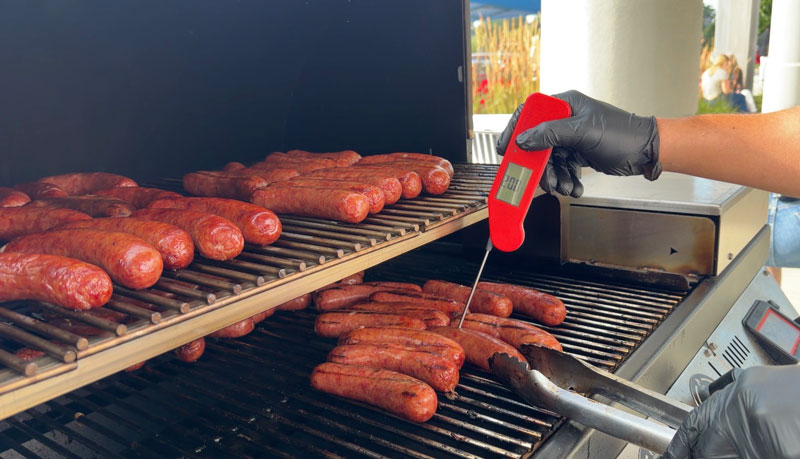
I cooked 3,000 pieces of meat at an event at our church, and when you’re doing large quantities, speed really does matter.
I’ve tested the Thermapen Nano over a 700-degree grill, and let’s be straight: no cheap thermometer is fast enough for me to hold my hand over a 700-degree grill very long, so let’s use a healthy dose of common sense on how we’ll really use food thermometers.
We’ve carried the new Thermapen Nano around with us for over a month now, and I’m truly impressed. If you like the Thermapen One, but you wish it was twice as fast, had a magnet on the back, and was lighter and thinner, the Thermapen Nano is the instant read you’ve been looking for.
Could I get it to hit .4 seconds on all of my tests? No. Did I get it to well exceed .4 on some tests? yes.
My testing methods are as scientific as I have the ability to make them, but I’m the first to admit that there’s potentially a healthy margin of error in my tests. However you view it, I think you’ll be really happy with the new Thermapen Nano if you’re ready for an upgrade. I know I’ve been incredibly impressed. This is definitely the best instant read thermometer I’ve ever used.
What We Love About the Thermoworks Thermapen Nano
- Unmatched speed
- Accuracy you can count on
- Auto-rotating display
- Intelligent backlight
- Magnet
- NIST traceable calibration certificate
- Thermoworks customer service is second to none
Where to purchase the Thermapen Nano
If you’re thinking about ordering the new Thermapen Nano, just use the links down below. If you decide to make a purchase, it will support our channel without costing you anything additional, and it keeps more testing like this coming.


Ken
October 5, 2026 4:17 pmDavid – Thanks for the review! I am impressed with the product. Before I buy, I was wondering how it compares to the Typhur InstaProbe that is a lot less inexpensive. Thank you!