
The Le Griddle Pro Series 75… It’s brand new, shiny, and… expensive. Is it worth the price of 5 Blackstones to build a stainless steel griddle into your outdoor kitchen? We’re going to find out.
Quick Links to the products mentioned in this post:
- Access VIP Pricing with code: BBQLAB at checkout!
- Le Griddle Pro Series 75 (3mm)
- Le Griddle Pro Series 75 (6mm)
- Le Griddle Pro Series 75 cart
- Le Griddle Pro Series 75 lid
- Insulating Liner for Le Griddle 75
- Le Griddle burger press
- Le Griddle tools
- Outdoor kitchen access doors
- Thermoworks weighted surface griddle probe
- Essential Equation Seasoning
In this article, we’re going to test low temperature over 30 minutes, high temperature over 30 minutes, test it in the wind to see if it can griddle without blowing out, check its cooking evenness, and a whole lot more. If you’re considering adding Le Griddle to your outdoor kitchen or patio, you’ve landed in the right place.
Le Griddle Pro Series 75 Features

Fuel Flexibility
The new Le Griddle Pro Series 75 is available in either propane or natural gas, and no matter which way you order it, the opposite orifices are included in case you change your mind down the road.
Stainless Steel Griddle Surface
It comes with either a 3mm cooking plate, like what we have here, or you can get it with a whopping 6mm plate for $500 more.
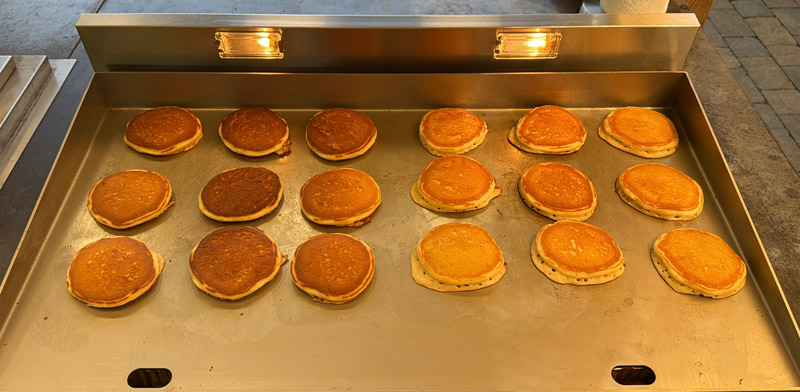
The cooking plate itself is HEAVY, made of 304 stainless steel and backed by cast iron to help with heat retention and distribution. It measures 29-3/8″ wide by 16-1/4″ deep, however with the cast iron plate only covering a portion of it, we generally don’t include the front 2 inches as cooking area.
However, even excluding that portion of the griddle top, we’re still left with enough space to comfortably cook 3 rows of 6 pancakes at a time, and that’s always helpful to know.
Stainless Steel Burners
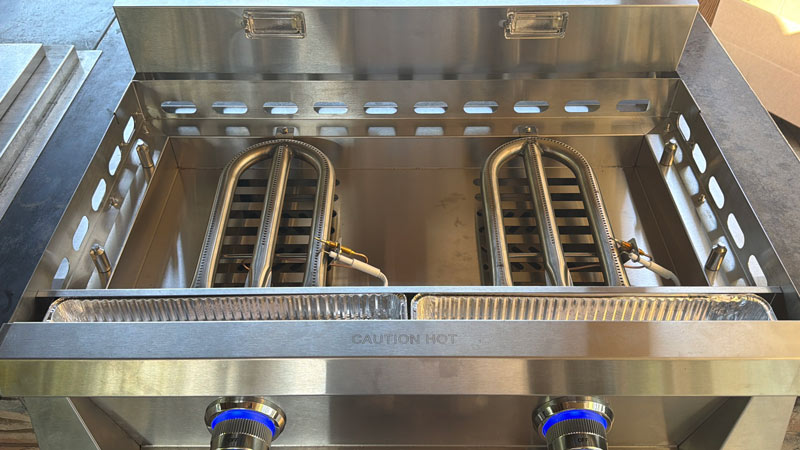
Underneath the cooking plate, you’ll find 2 U-shaped 304 stainless steel burners offering 9,000 BTU’s each. While we’re on the subject, the burners and valves come with a 10-year warranty, the body is covered for 5 years, and the griddle plate has a lifetime warranty.
For reference, we’ve had our original Le Griddle for 6 years now and haven’t had a single issue come up. The only reason we’re swapping it out is because Le Griddle wanted us to test their new model and show you the similarities and differences. So the model we did have here… it’s going to the Lab and you’ll see it in future content there.
What’s Different On The New Model Of Le Griddle?
Both this and our previous built-in flat top are Le Griddle, but there are 5 major differences with the new model that I want to point out.
- First, the Pro Series now has electrical features including lights on the knob, halogen lights for the griddle surface, and a logo projector. The previous model only required a gas hookup, but thankfully we had installed access panels where we needed them and there was an available outlet within range. We did have 1 challenge when installing the electric, but I’ll save that for a little bit later in the video. By the way, I mentioned warranty information a minute ago; the warranty on the electrical components is just 1 year.
- The next difference goes along with the first, but we thought it deserved its own callout. The new design includes push and spark ignition knobs. The previous model had a separate ignition button that you had to push, so I like this little upgrade.
- The next difference is the griddle surface. On the website they describe it as a “Texas Sea Glass Matte Finish”, but it appears to be a sand blasted stainless surface in an effort to be more forgiving of scratches. It’s still 304 stainless steel, but a noticeably different finish than what we knew on the previous version, so it will be interesting to see if it cooks food differently.
- Another very noticeable difference in the new version is the design of the grease tray. On the old model the entire width of the griddle plate sloped down into a removable tray. On the new model, we have 2 drain holes in the front emptying into 2 hidden grease trays. A door folds down in the front giving access to the grease trays for easy cleanup and I really like that it’s hidden.
- The fifth major difference between the new and old Le Griddle is where they’re made. The new Le Griddle is now manufactured right here in the USA and is proudly made in Texas.
Griddle Testing
Low Heat Ability
To understand the low heat control on the Le Griddle Pro Series 75, Melissa placed the weighted surface griddle probe from Thermoworks in the center of the griddle and graphed the temperature on low. She ignited both burners, turned them all the way to low, and set a timer for 15 minutes.
At 15 minutes, the center of the griddle was only measuring 190.8°. So she let the Le Griddle continue on low for an additional 15 minutes. After a total of 30 minutes the center of the griddle surface read 248.72°.
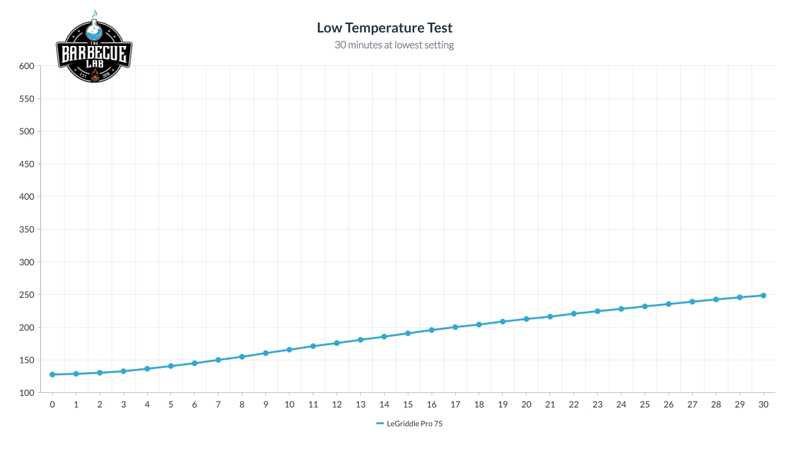
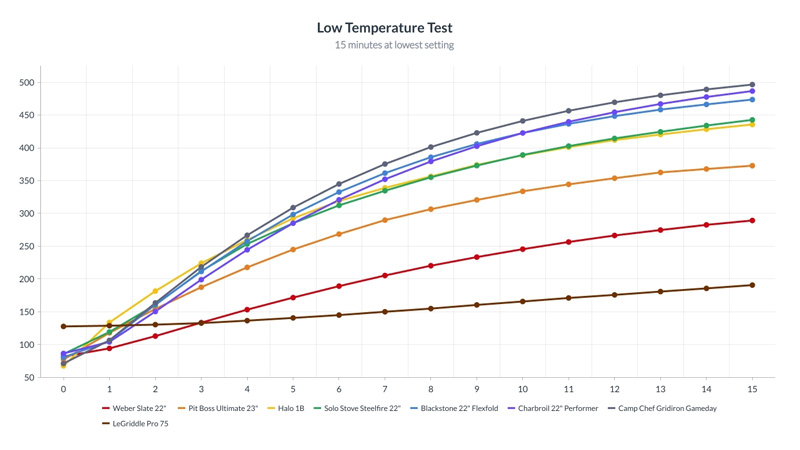
Most of the time when we run this test, griddles have far exceeded 300 or even 400° with just 15 minutes set to low, so the fact that the Le Griddle can maintain sub-300 temps for this long really sets it apart.
Even Heat Distribution
As we typically do when testing griddles, we ran the bread test at the end of our low-heat test to see how evenly the Le Griddle surface heated up.
Melissa placed pieces of white bread across the cooking surface and let it go for 5 minutes, still set to low. At the flip, this is what the bread looked like.
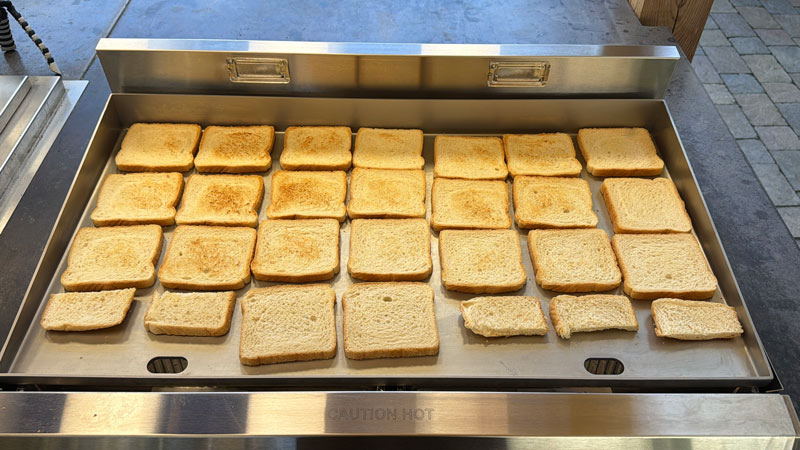
A couple of thoughts here. First, can we just talk about the fact that this griddle has been heating up on low for at least 35 minutes at this point, and this is the extent of the browning that this bread experienced after 5 minutes on the griddle? I don’t know if you saw our portable griddle roundup a couple of months ago, but I’ll just stick this here for comparison.
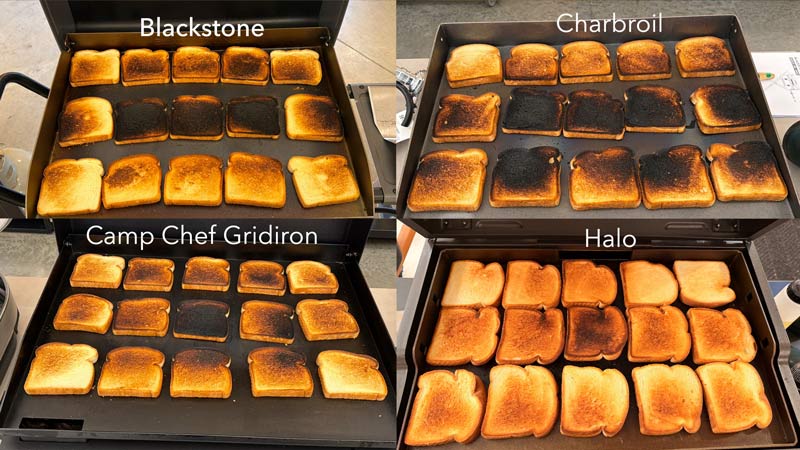
This Charbroil griddle had only been on low for 15 minutes before this bread went down and just look at it. It was completely incapable of holding a low temperature.
Ok, back to Le Griddle: The next thing we notice is that the front row of bread has no browning. This is expected, like I mentioned earlier, since the cast iron plate doesn’t cover the first couple of inches of the griddle plate.
Lastly, we also don’t see much browning on the far right side, so that’s something to keep our eye on in a little bit when we conduct our wind test in a few minutes.
High Heat Distribution
So now we know that the Le Griddle has pretty superior low temperature control and is able to maintain low temperatures for an extended period of time. We also know what things look like from a cooking evenness perspective.
The next question is how it handles high heat. So after cleaning up the bread crumbs and letting the griddle cool most of the way down, Melissa set both burners to high to see how hot and how fast the temperature would rise.
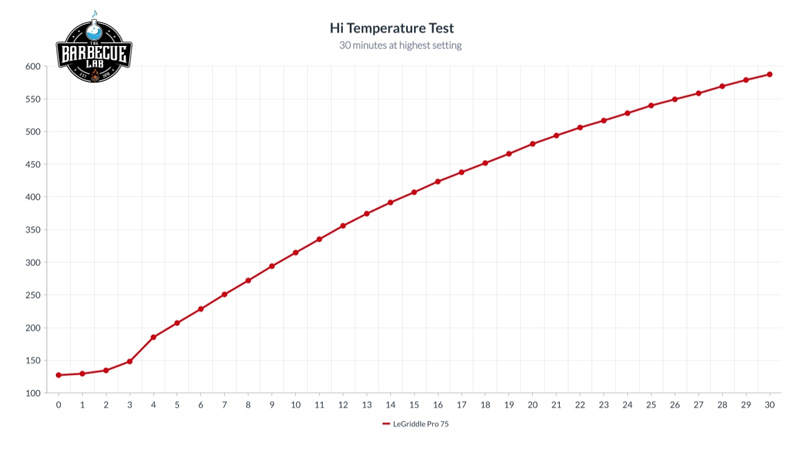
After 15 minutes, the center of the griddle was reading 391.5°, and at 30 minutes it had reached 587.5°. After owning a Le Griddle for 6 years and using this one for a couple of weeks, here’s what I can tell you.
These griddles will take longer to come up to temperature than what you may be used to on a cheaper griddle. But they will retain heat like it’s their job. Once they get hot, they stay hot.
It reminds me a lot of pizza ovens. The stones in my Fontana Volta 90 take longer to heat up than say an Ooni or Gozney oven, but that’s because the stones are more than twice as thick. But once they’re hot, they maintain their heat a lot better than the thinner stones and that’s why you pay more for them.
Question of the Day
In just a minute, we’re going to show you how the Le Griddle performs in windy conditions, but first, I have a question for you.
I think we can all agree that outdoor kitchen appliances are really expensive; certainly more expensive than what you would ever spend in a big box store for a cart model appliance.
But if you were building an outdoor kitchen and could only install 1 appliance, either for financial reasons or space constraints, what would it be?
Would it be a griddle like this? A gas grill? Kamado? I’ll leave my answer in the comments and let’s continue the conversation down there.
Wind Tolerance
I don’t know what it’s like where you live, but here in Indiana, our outdoor cooking is often affected by the wind. And griddles are one of the appliances that seem to be bothered the most, so we always try to test this when we review griddles.
While the Le Griddle surface is recessed, which typically helps, there are vent holes all the way around, so we want to see whether that’s going to affect its performance on a windy day.
Melissa set up a fan 20 inches from the griddle surface, leveled with the center of the fan at griddle level. Starting with a “cool” griddle, she lit both burners to high, and after 15 minutes, she took temperature readings at the far right, mid-right, center, mid-left, and far left points using the Thermoworks weighted griddle thermometer.
Later in the day, after it had time to cool back down, she ran the same test again without the fan and logged those numbers as well and charted the difference the fan made to the griddle performance.
The Le Griddle saw an average difference of 48.52° when the wind was blowing.
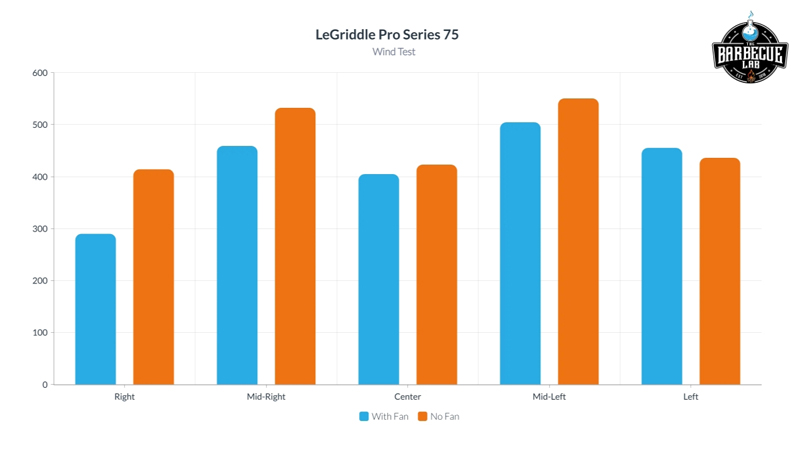
I know it’s not fair to compare this griddle to a MUCH less expensive portable model, but to put these results in perspective, the winner of the portable roundup in this category was the Blackstone Flexfold with an average difference of 84.92° on the same test.
We’ve also previously compared our original Le Griddle to the Solo Stove Steelfire, and when we tested that one last November, it had an average difference of 75.65°.
So, all that to say, if you build the new Le Griddle into your outdoor kitchen, a reasonable amount of wind should not pose too much trouble for you.
Smash Burger Sear Test
Probably our favorite food to cook on griddles is smash burgers, so that’s always something we want to test when we review a new flat top. We’ve smashed hundreds of burgers on our original Le Griddle; in fact, we filmed our “Overthinker’s guide to the perfect smash burger” on that griddle, so I’m really hoping this new model sears burgers at least that well.
I preheated the Le Griddle to 500° before smashing our patties. By the way, this new Le Griddle burger press is legit. I’ve used a ton of burger smashers over the years, and I’m really impressed with this one, especially for the price.
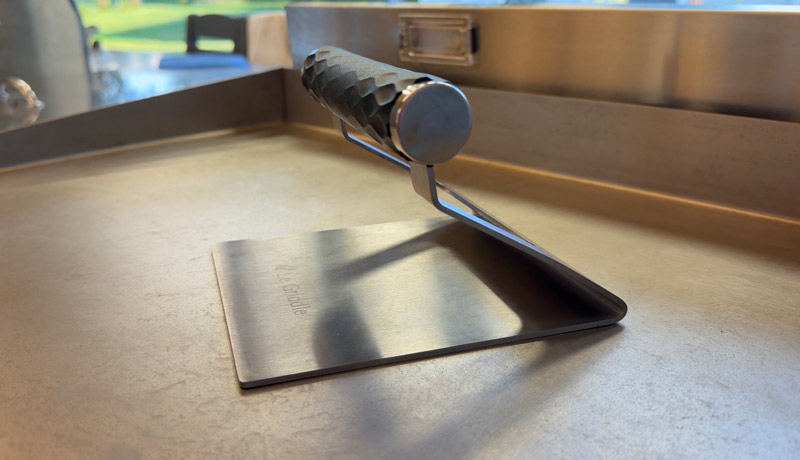
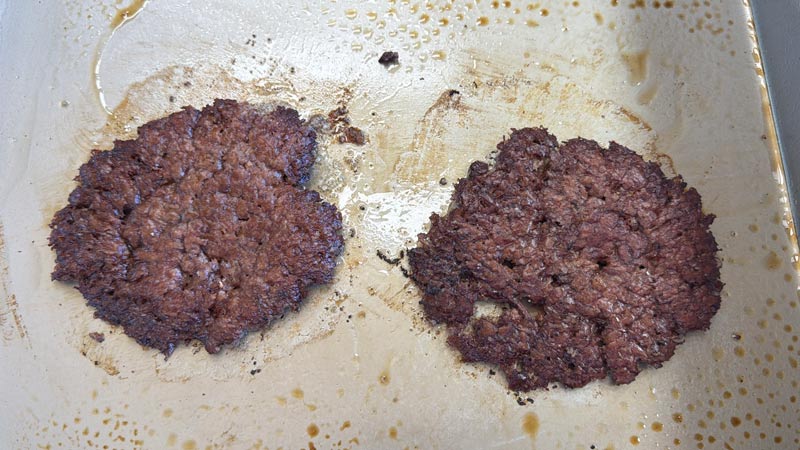
I let the burgers go for about 90 seconds on the first side with a healthy dose of our Essential Equation salt, pepper, garlic seasoning, which I personally believe everyone should have at home. We make it small batch in the Lab kitchen.
At the flip, here’s how the sear looked. Delicious crispy edges and complete crust across the entire patty. Thankfully, Le Griddle still knows how to put a mean sear on smash burgers.
Grease Management
I don’t know if you’ve ever cleaned a griddle with a stainless steel cooktop before, but they can be surprisingly easy to clean, and Le Griddle actually recommends throwing ice down to break up the cooked on food particles. Some ice cubes, a bottle of water, a good scraper, and a Scotch-Brite sponge will do wonders for getting this cooking surface clean.
Now, I mentioned a few minutes ago the new grease management setup on this model, but let’s unpack that a little more. There are times that I love and prefer this, and also times when I kind of miss the old way.
This new system is thoughtfully designed to help you keep liquid on the griddle surface. Whether it’s sauces, oil, or water, the liquid will pool and not go down the drain unless you specifically tell it to.
However, the downside is that I tend to use a lot of water and ice when I clean my Le Griddle, and it takes what feels like forever to drain all that liquid when I’m finally done with it.
I guess when I think about it, probably the reason I use so much ice and water is because I was used to losing so much of it into the grease trap. I probably just need to retrain myself to use less moving forward.
On the plus side, I didn’t lose any of my food into the removable grease tray during our test cooks, which used to happen all the time with the previous generation. But probably the best part is that the grease tray is now two trays, with aluminum tray liners available, making it much easier to clean up after a cook. The old tray was long and very shallow in the back and it was tricky getting that emptied without making a mess.
So overall, I think I do like this new setup, but I just need to make some adjustments personally to make it work better for me.
Also, the absolute best part about stainless steel griddles is that there’s no seasoning required, which is a huge hassle with the cold rolled steel big box griddles we’re surrounded with. Stainless steel cooking surfaces won’t rust either, which makes this a wonderful solution for building something long-term into an outdoor kitchen.
My Final Thoughts
Here’s a few remaining thoughts and things we’ve learned during this testing.
First, I mentioned earlier that we had a little challenge installing the electric. On the Le Griddle Pro 75, the gas line comes from the left side and the electric line comes from the right. We were installing this on the same liner we’ve been using with the original Le Griddle, with a cutout only available on the left side. It was a real stretch getting the electrical line to run through the liner to plug into the transformer mounted below.
I later learned that Le Griddle does have an extension available if you ask for it. So, if you’re planning on installing the Le Griddle in the liner, tell them David says you need the electrical extension and they’ll make sure you get it.
The next thing we learned is that the burners can be adjusted; in fact, if you convert your griddle from LP to natural gas or vise versa, you actually will need to adjust the burners. It’s not too hard to do, and it’s actually spelled out pretty well with pictures in the manual if you actually take the time to read it. (Read Your Manuals, They’re Often Helpful.)
Long story, but we originally planned on the LP version of the Le Griddle to use at the Lab, but changed our minds and decided to bring it back home instead. We converted it to natural gas by changing the orifices, but then discovered that we also needed to make adjustments to the burners as well, so we just figured that learning was worth a mention here.
There is a cart available if you’d rather that configuration instead of building it in.
And a lid is also available if you’d like to keep your Le Griddle covered. I do know that the new Le Griddle design will require the new lid design. We weren’t able to install our old lid on the new Le Griddle because of the raised light panel in the back.
So, is the new Le Griddle Pro 75 worth the price of 5 brand new Blackstones? If you have the money, you’re going to appreciate and enjoy this griddle. It will easily outlast any Blackstone I’ve ever cooked on and the top is so much easier to care for.
If it’s more than you want to spend, there are plenty of griddle options out there that aren’t designed with the outdoor kitchen in mind, and you can view your options in our Best Griddle Roundup. The best griddle for you is something only you can decide, but with 6 years of experience cooking on Le Griddle, I’d choose it again easily.
If you’re interested in checking out the new Le Griddle Pro 75, you can access VIP pricing by using our discount code BBQLAB at checkout. What didn’t we test that you’re curious about? Leave us a comment below, and we’ll answer as many as we’re able in the coming weeks and months.

Melissa Gafford
September 4, 2026 5:12 pmIf I could only install 1 appliance in my outdoor kitchen, I think it would be a kamado. I’m a sucker for food grilled over charcoal, and I appreciate the versatility in cooking styles it offers.